


Page 127 - Theory and Design of Air Cushion Craft
P. 127
Sidewall wave-making  drag  1 1 1

             1,9  SWewall


          Equivalent  cushion  beam   method

          SES  with  thin  sidewalls  create  very  little  wave-making  drag,  owing  to  their  high
          length/beam  ratio,  which may be up  to  3CMO. To simplify  calculations  this drag  may
          be included in the wave-making drag due to the air cushion and calculated  altogether,
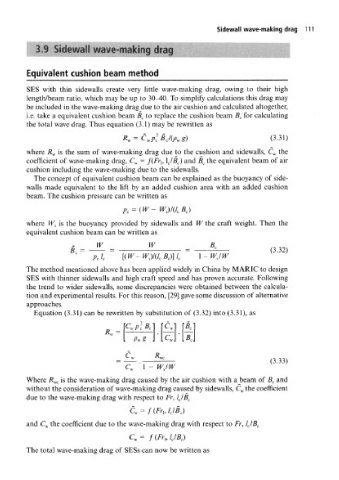
          i.e. take  a equivalent cushion  beam  B c to  replace the cushion  beam  B c for  calculating
          the total  wave drag. Thus equation  (3.1) may be rewritten as
                                    R w=C wp;BJ(p wg)                        (3.31)

          where  R w  is the  sum  of  wave-making drag  due  to  the  cushion  and  sidewalls,  C w  the
          coefficient  of  wave-making drag,  C w  =  f(Fr b  \JB C)  and  B c the  equivalent beam  of  air
          cushion  including the wave-making due to  the sidewalls.
            The concept  of  equivalent cushion beam can be explained  as the buoyancy of  side-
          walls  made  equivalent  to  the  lift  by  an  added  cushion  area  with  an  added  cushion
          beam. The cushion pressure can be written  as


          where  W s  is the  buoyancy  provided  by  sidewalls and  W  the  craft  weight.  Then  the
          equivalent cushion  beam  can be written as
                             W              W                B
                      B c = — = - - - = - ^ -                                           (3.32)
                              i
                            Pc c    [(w-wy(i Bj\i c       \-wjw
                                              c
          The method  mentioned above has been applied widely in China by MARIC to design
          SES with thinner  sidewalls and  high craft  speed  and  has  proven  accurate.  Following
          the  trend  to  wider  sidewalls,  some  discrepancies  were obtained  between  the  calcula-
          tion and experimental results. For this reason,  [29] gave some discussion of  alternative
          approaches.
            Equation  (3.31) can  be rewritten by substitution of  (3.32) into (3.31), as

                                                      A
                                                      B r


                                                                             (3.33)
                                     C    1 -  WW
          Where  R wc is the wave-making drag caused  by the air cushion with a beam  of  B c  and
          without the consideration of wave-making drag caus_ed by sidewalls, C w the  coefficient
          due  to  the wave-making drag with respect  to  Fr,  IJB C
                                         =  f     IJB C)
                                       C w   (Fr b
          and  C w the coefficient  due to  the wave-making drag with respect to  Fr,  IJB C

                                      C w =  f(Fr hlJBJ
          The total wave-making drag of  SESs can now be written as

