


Page 117 - Theory and Design of Air Cushion Craft
P. 117
Skirt  drag  101

           Fj  the  jet  velocity  from  the  stern  cushion,  /  the  thickness  of  the  jet  from  the  stern
          cushion  and  cr t the  surface tension  of  water.
            The water friction of the stern skirt will decrease due to two-phase flow through  the
          gap  under  the  segment  tips  or  bag  lower  point,  since  the  turbulent  air  flow  creates
          dense  spray.

          Skirt  pressure  drag,  /? sp

          This  may be written  as
                                                                             (3.15)
          As  mentioned  above,  the  various  components  of  skirt  drag,  such  as friction  drag  in
          two-phase flow, the inertia drag of  the skirt due  to the  flutter  of  the  skirt  fabric  and
          spray  drag of skirts at both  sides of the craft, are difficult  to calculate. For this reason,
          the total  skirt drag  is best estimated  by experience-based  formulae [25, 26], as  follows:
                                                                             (3.16)
                                          +
                                                                             (3.17)
                                                                             (3.18)
                                 C sk2 =  {[2.8167

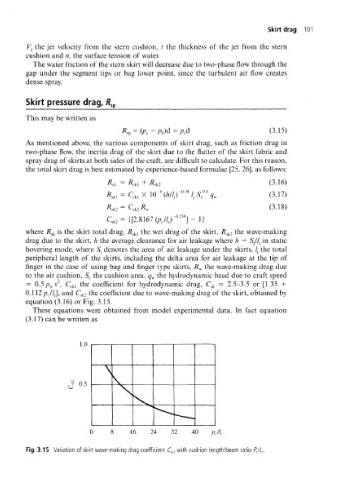
          where  R sk  is the  skirt total  drag,  /? skl  the  wet drag  of  the  skirt, R sk2  the  wave-making
          drag  due  to  the  skirt, h the  average clearance  for  air  leakage  where  h  =  Sj/lj  in  static
          hovering  mode,  where  S- }  denotes  the  area  of  air  leakage under  the  skirts,  /,  the  total
          peripheral  length  of  the  skirts,  including  the  delta  area  for  air  leakage  at  the  tip  of
          finger in  the  case  of  using  bag  and  finger  type  skirts, R w  the  wave-making  drag  due
          to  the air cushion,  S c the cushion  area,  q w the  hydrodynamic  head  due to  craft  speed
          =  0.5/? w v",  C skl  the  coefficient  for  hydrodynamic  drag,  C sk  =  2.5-3.5  or  [1.35  +
          0.112/? c// c], and  C sk2 the coefficient  due to wave-making drag of  the skirt, obtained  by
          equation  (3.16)  or  Fig.  3.15.
            These  equations  were  obtained  from  model  experimental  data.  In  fact  equation
          (3.17) can be written as


                         1.0


                         0.5


                            0     8    16    24   32    40    p c/l c

          Fig. 3.15  Variation of  skirt wave-making  drag coefficient  C sk2 with cushion  length/beam  ratio  PJL C.

