


Page 182 - Theory and Design of Air Cushion Craft
P. 182
Calculation of ACV transverse stability  165

          Separated   bag  or  cell
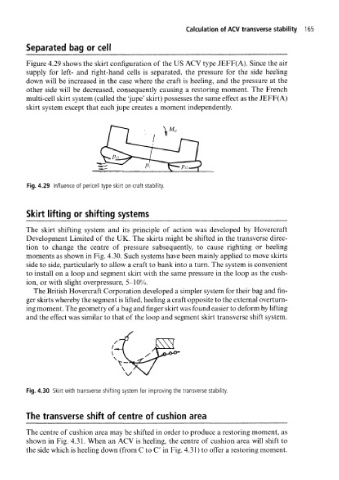
          Figure  4.29 shows the skirt configuration of the US ACV type JEFF(A). Since the air
          supply  for  left-  and  right-hand  cells  is  separated,  the  pressure  for  the  side  heeling
          down  will be increased  in  the  case  where the  craft  is heeling, and  the  pressure  at  the
          other  side  will be  decreased,  consequently  causing  a  restoring  moment.  The  French
          multi-cell skirt system (called the 'jupe' skirt) possesses  the same effect  as the JEFF(A)
          skirt  system except  that  each jupe creates  a moment  independently.


          Fig. 4.29  Influence of  pericell type skirt  on craft  stability.


          Skirt  lifting or  shifting  systems

          The  skirt  shifting  system  and  its  principle  of  action  was  developed  by  Hovercraft
          Development  Limited  of  the UK.  The skirts might be shifted  in the transverse direc-
          tion  to  change  the  centre  of  pressure  subsequently,  to  cause  righting  or  heeling
          moments  as shown in Fig. 4.30. Such systems have been mainly applied  to move skirts
          side to  side, particularly to allow a craft  to bank into a turn. The system is convenient
          to install on a loop  and  segment skirt with the same pressure  in the loop  as the  cush-
          ion,  or with slight  overpressure,  5-10%.
            The British Hovercraft Corporation  developed a simpler system for their bag and fin-
          ger skirts whereby the segment is lifted, heeling a craft  opposite to the external overturn-
          ing moment. The geometry of a bag and finger skirt was found easier to deform by lifting
          and the effect  was similar to that of the loop and  segment skirt transverse shift  system.


          Fig. 4.30  Skirt with transverse  shifting  system for  improving the  transverse  stability.


          The transverse   shift  of  centre  of  cushion area

          The centre of cushion  area  may be shifted in order to produce  a restoring moment,  as
          shown  in  Fig.  4.31. When  an  ACV is heeling, the  centre  of  cushion  area  will  shift  to
          the side which is heeling down (from C to C'  in Fig. 4.31) to offer  a restoring  moment.

