


Page 183 - Theory and Design of Air Cushion Craft
P. 183
166  Stability


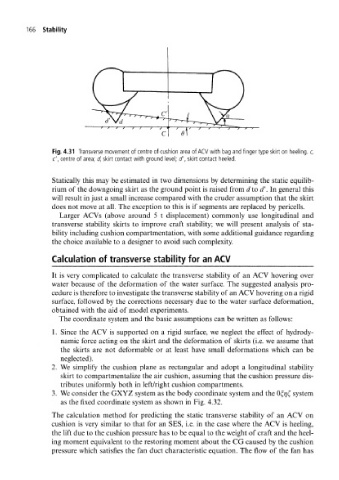
             Fig. 4.31  Transverse  movement  of  centre of cushion area  of ACV with  bag and finger  type skirt on heeling,  c,
              c', centre of area;  d, skirt contact with ground  level; d', skirt contact  heeled.


             Statically this may be estimated  in two dimensions by determining the  static equilib-
             rium of  the downgoing skirt as the ground  point  is raised from  d to d'. In general this
             will result in just a small increase compared  with the cruder assumption  that  the skirt
             does  not  move at all. The  exception  to  this is if segments are  replaced  by pericells.
               Larger  ACVs  (above  around  5  t  displacement)  commonly  use  longitudinal  and
             transverse  stability  skirts  to  improve  craft  stability;  we  will  present  analysis of  sta-
             bility including cushion compartmentation,  with some additional  guidance  regarding
             the choice  available to a designer to  avoid  such complexity.

             Calculation  of  transverse  stability for  an ACV

             It  is very complicated  to  calculate  the  transverse  stability of  an  ACV  hovering  over
             water  because  of  the  deformation of  the  water  surface. The  suggested  analysis  pro-
             cedure is therefore to investigate the transverse stability of an ACV hovering on a rigid
             surface,  followed  by the  corrections necessary due  to  the  water  surface deformation,
             obtained  with the  aid of  model  experiments.
               The coordinate system and  the basic assumptions  can be written as  follows:

             1.  Since the  ACV  is supported  on  a  rigid  surface,  we  neglect  the  effect  of  hydrody-
                namic force acting on  the  skirt  and  the  deformation  of  skirts (i.e. we assume  that
                the  skirts  are  not  deformable  or  at  least  have  small  deformations  which  can  be
                neglected).
             2.  We  simplify  the  cushion  plane  as  rectangular  and  adopt  a  longitudinal  stability
                skirt to compartmentalize the air cushion,  assuming that  the cushion  pressure dis-
                tributes  uniformly  both in left/right  cushion  compartments.
             3.  We consider the GXYZ system as the body coordinate  system and  the O^C system
                as the fixed coordinate  system as shown in Fig. 4.32.
             The  calculation  method  for  predicting  the  static  transverse  stability  of  an  ACV  on
             cushion  is very similar to  that  for  an  SES,  i.e.  in  the  case  where the  ACV  is heeling,
             the lift  due to the cushion pressure has to be equal to the weight of craft and the heel-
             ing moment  equivalent to the restoring moment  about the CG caused  by the cushion
             pressure  which satisfies  the  fan  duct  characteristic  equation.  The flow of  the  fan  has

