


Page 185 - Theory and Design of Air Cushion Craft
P. 185
168  Stability

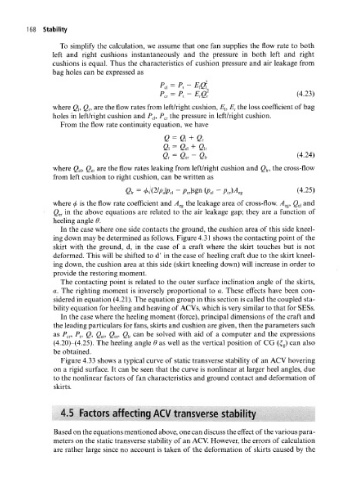
                To simplify  the  calculation,  we assume  that  one fan  supplies the flow rate  to  both
              left  and  right  cushions  instantaneously  and  the  pressure  in  both  left  and  right
              cushions is equal.  Thus the  characteristics  of  cushion  pressure  and  air  leakage  from
              bag holes can be expressed as
                                              = P t-  3G?
                                           P d
                                           ^cr =  Pt  -  E rQl                   (4.23)
              where  (?,, Q r, are the flow rates from  left/right cushion, E b  E T the loss coefficient  of  bag
              holes in left/right  cushion and  P d,  P CT  the pressure in left/right  cushion.
                From the flow rate continuity equation,  we have

                                             6 = a + a
                                            Q^  = & + a,
                                            a  =  Gar -  81,                     (4-24)
              where Q el, Q er are the flow rates leaking from left/right cushion  and  Q ]r, the cross-flow
              from  left  cushion  to right cushion, can  be written as
                                  a r = W(2/A,lA:i -  /^crlsgn  (p d  -  p CT)A eg  (4.25)
              where  </>  is the  flow rate coefficient  and  A eg  the  leakage area  of  cross-flow. A eg,  Q d  and
              Qer  in  the  above  equations  are  related  to  the  air  leakage  gap; they  are  a function of
              heeling angle 9.
                In the case where one side contacts the ground,  the cushion area  of this side kneel-
              ing down may be determined as follows.  Figure 4.31 shows the contacting point of  the
              skirt  with  the  ground,  d,  in  the  case  of  a  craft  where  the  skirt  touches  but  is  not
              deformed. This will be shifted to d' in the case of heeling craft due to the skirt  kneel-
              ing down, the cushion area  at this side (skirt kneeling down) will increase in order  to
              provide the restoring  moment.
                The contacting point  is related  to  the  outer  surface  inclination angle of  the skirts,
              a. The  righting moment  is inversely proportional  to  a. These  effects  have been  con-
              sidered in equation  (4.21). The equation  group in this section is called the coupled  sta-
              bility equation for heeling and heaving of ACVs, which is very similar to that for SESs.
                In the case where the heeling moment (force), principal  dimensions of the craft  and
              the leading particulars for fans, skirts and cushion are given, then the parameters  such
              as  P cr, P t,  Q,  Q e[,  Q er, Q h can  be  solved with aid  of  a computer  and  the  expressions
              (4.20)-(4.25). The heeling angle 9 as well as the  vertical position  of  CG  (£ g) can  also
              be obtained.
                Figure 4.33 shows a typical  curve of  static transverse stability of  an ACV hovering
              on  a rigid surface. It can  be seen that the curve is nonlinear at larger heel angles, due
              to the nonlinear factors of fan characteristics and ground contact  and deformation of
              skirts.


                4.5   Factors affecting ACV transverse stability


              Based on the equations mentioned above, one can discuss the effect of the various para-
              meters on the static transverse stability of  an ACV. However, the errors of  calculation
              are rather large since no  account is taken  of  the deformation  of  skirts caused by the

