


Page 187 - Theory and Design of Air Cushion Craft
P. 187
170  Stability

              Transverse stability of  an ACV without the   cushion
              compartmentation

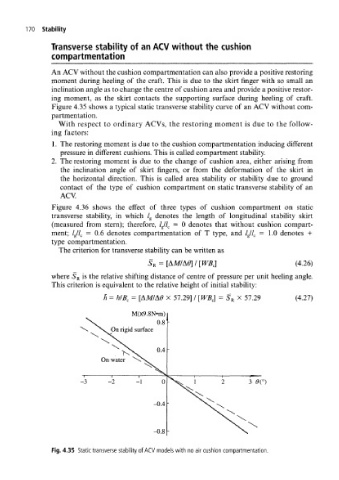
              An ACV without the cushion compartmentation  can also provide a positive restoring
              moment  during  heeling of  the  craft.  This  is due  to  the  skirt finger with  so small  an
              inclination angle as to change the centre of cushion area and provide a positive restor-
              ing  moment,  as  the  skirt  contacts  the  supporting  surface  during  heeling  of  craft.
              Figure 4.35 shows a typical  static transverse  stability  curve  of  an ACV without  com-
              partmentation.
                With  respect  to  ordinary  ACVs,  the restoring  moment  is due to  the  follow-
              ing  factors:
              1.  The  restoring moment  is due  to  the cushion compartmentation  inducing  different
                pressure  in different  cushions. This is called  compartment  stability.
              2.  The restoring  moment  is due  to  the  change  of  cushion  area,  either  arising  from
                the  inclination  angle  of  skirt  fingers,  or  from  the  deformation  of  the  skirt  in
                the  horizontal  direction.  This  is  called  area  stability  or  stability  due  to  ground
                contact  of  the  type  of  cushion  compartment  on  static transverse  stability of  an
                ACV
              Figure  4.36  shows  the  effect  of  three  types  of  cushion  compartment  on  static
              transverse  stability,  in  which  / g  denotes  the  length  of  longitudinal  stability  skirt
              (measured  from  stern);  therefore, // c  =  0  denotes  that  without  cushion  compart-
                                           / g
              ment;  / g// c  =  0.6  denotes  compartmentation  of  T  type,  and  / g// c  =1.0  denotes  +
              type  compartmentation.
                The criterion for transverse  stability  can be written  as


              where  5" R  is the  relative shifting  distance  of  centre of  pressure per  unit heeling angle.
              This criterion  is equivalent to  the  relative height of  initial stability:
                            h =  h/B c  =  [AM/A0  X 57.29] /  [WB C]  = S R  X  57.29  (4.27)

                                    M(x9.8N«m)
                                           0.8
                              On rigid  surface


                                                                    3  6>(°)


              Fig. 4.35  Static transverse stability  of ACV models with  no air cushion compartmentation.

