


Page 190 - Theory and Design of Air Cushion Craft
P. 190
Dynamic stability, plough-in and overturning  173


                            0.2-
                                                                water
                                                                ground
                            0.1 -


                                         5        10    0(°)

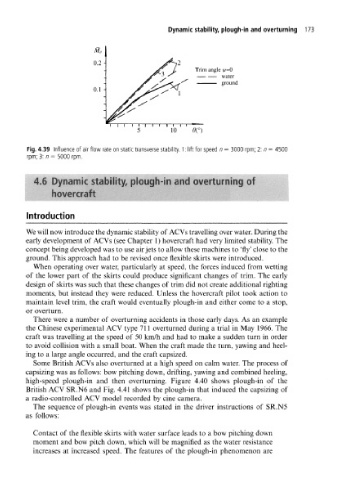
          Fig.  4.39 Influence of air flow rate on static transverse stability.  1: lift for speed n — 3000 rpm; 2: n =  4500
          rpm;  3: n =  5000 rpm.

            4.6  Dynamic stability, plough-in      and overturning of

                 hovercraft
                 hfiwiarrraft
          Introduction


          We will now introduce  the dynamic stability of ACVs travelling over water. During  the
          early development  of  ACVs  (see Chapter  1) hovercraft  had  very limited stability. The
          concept  being developed was to use air jets to allow these machines to  'fly' close to the
          ground.  This approach had  to be revised once flexible skirts were introduced.
            When  operating  over water, particularly  at  speed,  the  forces  induced  from wetting
          of  the  lower part  of  the  skirts could  produce  significant changes  of  trim.  The  early
          design of  skirts was such that  these changes of  trim did not  create additional righting
          moments,  but  instead  they  were reduced.  Unless  the  hovercraft  pilot  took  action  to
          maintain  level  trim,  the craft  would  eventually plough-in  and  either  come  to  a  stop,
          or  overturn.
            There  were a number  of  overturning  accidents  in those  early days. As  an  example
          the  Chinese experimental ACV type  711 overturned during a trial  in May  1966. The
          craft  was travelling at  the  speed  of  50 km/h  and  had  to  make  a sudden  turn  in order
          to  avoid  collision with a small boat. When the  craft  made  the turn, yawing and  heel-
          ing to  a large angle occurred,  and  the craft  capsized.
            Some  British ACVs  also overturned  at  a high  speed  on  calm  water. The  process  of
          capsizing was as follows:  bow pitching down, drifting,  yawing and  combined  heeling,
          high-speed  plough-in  and  then  overturning.  Figure  4.40 shows  plough-in  of  the
          British ACV SR.N6 and Fig.  4.41 shows the plough-in  that  induced  the  capsizing  of
          a  radio-controlled  ACV model  recorded  by cine  camera.
            The  sequence of plough-in  events was  stated  in  the  driver  instructions  of  SR.N5
          as  follows:

            Contact of  the flexible skirts with water surface leads to  a bow pitching  down
            moment  and  bow pitch  down,  which will be magnified as the water  resistance
            increases  at  increased  speed.  The  features  of  the  plough-in  phenomenon  are

