


Page 195 - Theory and Design of Air Cushion Craft
P. 195
178  Stability


                            -10


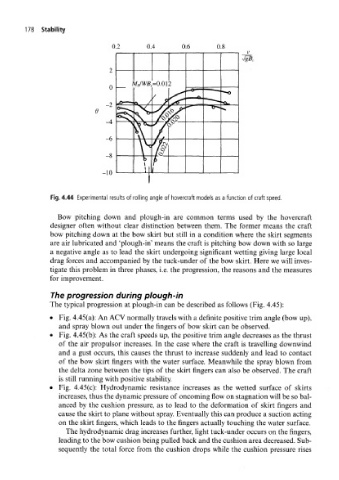
             Fig.  4.44  Experimental  results of  rolling angle  of  hovercraft  models as a function of craft  speed.

               Bow  pitching  down  and  plough-in  are  common  terms  used  by  the  hovercraft
             designer  often  without clear  distinction  between  them.  The  former  means  the  craft
             bow pitching down at the bow skirt but  still in a condition  where the  skirt segments
             are air lubricated  and  'plough-in' means  the craft  is pitching bow down with so large
             a  negative angle  as to  lead  the  skirt undergoing significant  wetting giving large local
             drag  forces  and  accompanied  by the tuck-under  of  the  bow skirt. Here we will inves-
             tigate this problem  in three phases,  i.e. the progression, the reasons  and  the  measures
             for  improvement.

             The progression during plough-in
             The typical progression  at plough-in can  be described  as follows  (Fig. 4.45):
             •  Fig. 4.45(a): An ACV normally travels with a definite positive trim angle (bow up),
                and  spray blown out under  the fingers  of  bow skirt can  be observed.
             •  Fig.  4.45(b): As the craft  speeds up, the positive trim angle  decreases as the thrust
                of  the  air  propulsor  increases.  In  the  case  where the  craft  is travelling downwind
                and  a gust  occurs, this causes the thrust  to  increase  suddenly and  lead  to  contact
                of  the  bow  skirt fingers  with the  water  surface. Meanwhile the  spray  blown  from
                the delta zone between  the tips of  the skirt fingers can also be observed. The  craft
                is still running with positive stability.
             •  Fig.  4.45(c):  Hydrodynamic  resistance  increases  as  the  wetted  surface  of  skirts
                increases, thus the dynamic pressure of oncoming flow on stagnation  will be so bal-
                anced  by the  cushion  pressure,  as to  lead  to  the  deformation  of  skirt fingers  and
                cause the skirt to plane without spray. Eventually this can produce  a suction  acting
                on the skirt fingers,  which leads to  the fingers  actually touching the water surface.
                  The hydrodynamic drag increases further,  light tuck-under occurs on the  fingers,
                leading to the bow cushion being pulled back and the cushion area decreased.  Sub-
                sequently  the  total  force  from  the  cushion  drops  while the  cushion  pressure  rises

