


Page 200 - Theory and Design of Air Cushion Craft
P. 200
Dynamic  stability,  plough-in  and  overturning  183

            positive stability is practical has been greatly extended, and  sensitivity to plough-in
             and capsizing has been significantly reduced.
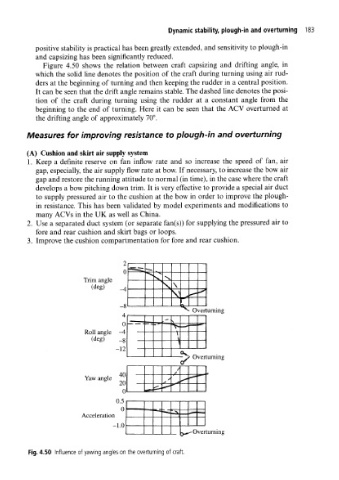
               Figure  4.50  shows  the  relation  between  craft  capsizing  and  drifting  angle,  in
            which the solid line denotes the position  of  the craft  during turning using air rud-
             ders at the beginning of turning and then keeping the rudder in a central  position.
             It can be seen that  the drift  angle remains stable. The dashed  line denotes the posi-
             tion  of  the  craft  during  turning  using  the  rudder  at  a  constant  angle  from  the
             beginning to  the  end  of  turning.  Here  it can  be  seen  that  the ACV overturned  at
             the drifting angle of  approximately  70°.

          Measures   for  improving resistance  to plough-in   and overturning

          (A)  Cushion and skirt air supply system
          1.  Keep  a  definite  reserve  on  fan  inflow  rate  and  so  increase  the  speed  of  fan, air
             gap, especially, the air supply flow rate at bow. If  necessary, to increase the bow air
             gap and restore the running attitude to normal (in time), in the case where the craft
             develops a bow pitching down trim. It is very effective  to provide a special air duct
             to  supply pressured  air to  the cushion at the bow in order  to improve  the  plough-
             in  resistance. This  has  been  validated  by model experiments  and  modifications  to
             many ACVs in the UK  as well as  China.
          2.  Use a separated  duct  system (or separate fan(s))  for supplying the pressured  air  to
             fore  and  rear cushion and  skirt bags or  loops.
          3.  Improve  the cushion compartmentation for fore  and  rear cushion.


                                     L
                                     0 *i^
                                           *V
                          Trim angle         x N,
                            (deg)   _4     —   * \ \     *s
                                                  V   .4 *~
                                     8              ft—
                                                        Overturning
                                                ^ H
                                    0             V .— *•  •^•a
                          Roll angle  -4           \
                            (deg)   o               \
                                                    '
                                   — 12.
                                                    <*v >  Overturning
                                                    c/
                                                   /
                                                   /
                          v     i  40            />
                          Yaw angle
                               *    20          S  .*  ^  *— •
                                    0        ^  .--
                                   0.5
                                    0      ••••i «-s
                         Acceleration          •— •» -^  ^
                                   1 0
                                                     -^^- Overturning

           Fig. 4.50  Influence of yawing  angles on the  overturning  of craft.

