


Page 201 - Theory and Design of Air Cushion Craft
P. 201
184  Stability

             4.  Increase  the bag-cushion pressure  ratio  of  skirt bags and  the bow skirt separately
                if  the  bag is divided, to  increase the  stiffness  of  the  bag  of  the  bow skirt.

             (B)  Skirt systems
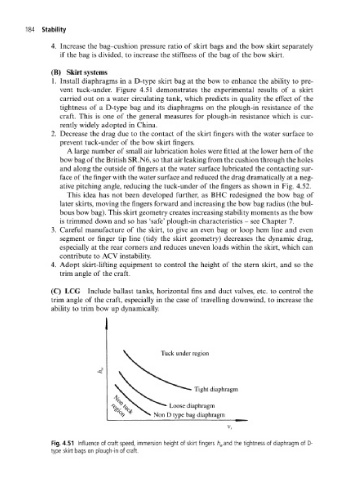
             1.  Install diaphragms  in a D-type  skirt  bag  at  the bow to  enhance  the  ability to  pre-
                vent  tuck-under.  Figure  4.51  demonstrates  the  experimental  results  of  a  skirt
                carried  out  on  a water circulating tank, which predicts  in quality the  effect  of  the
                tightness  of  a  D-type  bag  and  its  diaphragms  on  the  plough-in  resistance  of  the
                craft.  This  is  one  of  the  general  measures  for  plough-in  resistance  which  is  cur-
                rently widely adopted  in China.
             2.  Decrease  the drag due to  the contact  of  the skirt fingers  with the water surface to
                prevent tuck-under  of  the bow skirt  fingers.
                  A large number of  small air lubrication holes were fitted  at the lower hem of  the
                bow bag of the British SR.N6, so that air leaking from the cushion through the holes
                and  along the outside of fingers at the water surface lubricated  the contacting  sur-
                face of the finger with the water surface and reduced the drag dramatically at a neg-
                ative pitching angle, reducing the tuck-under of  the fingers as shown in Fig.  4.52.
                  This  idea  has  not  been  developed  further,  as  BHC  redesigned  the  bow  bag  of
                later  skirts, moving the fingers forward and increasing the bow bag radius (the bul-
                bous bow bag). This skirt geometry creates increasing stability moments as the bow
                is trimmed  down and so has 'safe' plough-in characteristics -  see Chapter 7.
             3.  Careful manufacture  of  the  skirt,  to  give an  even  bag  or  loop  hem  line and  even
                segment  or  finger  tip  line  (tidy  the  skirt  geometry)  decreases  the  dynamic  drag,
                especially at the rear  corners and  reduces  uneven loads within the skirt, which can
                contribute  to ACV instability.
             4.  Adopt  skirt-lifting  equipment  to  control  the  height  of  the  stern  skirt,  and  so  the
                trim angle of  the craft.

             (C)  LCG  Include  ballast  tanks,  horizontal fins and  duct  valves, etc.  to control  the
             trim  angle  of  the  craft,  especially in the  case  of  travelling downwind, to  increase  the
             ability to trim bow up dynamically.


                                           Tuck under region


                                                    Tight diaphragm
                                              Loose diaphragm
                                         Non D type bag diaphragm


             Fig.  4.51  Influence  of  craft  speed,  immersion  height  of  skirt fingers  h war\6  the  tightness  of  diaphragm  of D-
             type  skirt  bags on  plough-in  of  craft.

