


Page 202 - Theory and Design of Air Cushion Craft
P. 202
Overturning  in waves  185

                                                                    no air lubrication
                                                                    air lubrication
                                                                    @  yaw angle=0


                               -1.0  -2.0  -3.0  -4.0  -5.0  -6.0  -7.0  trim angle

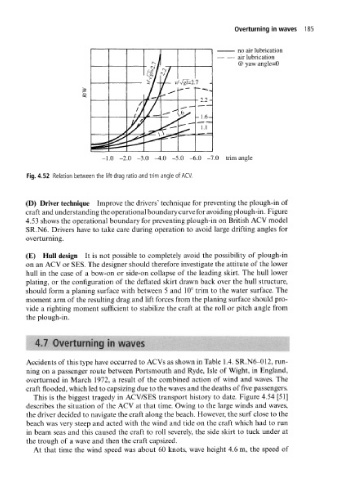
          Fig. 4.52  Relation between the  lift-drag  ratio and trim  angle of ACV.


          (D)  Driver technique  Improve  the drivers' technique for preventing the plough-in of
          craft  and understanding the operational boundary curve for avoiding plough-in.  Figure
          4.53 shows the operational  boundary  for preventing plough-in  on British ACV model
          SR.N6.  Drivers  have to  take  care  during  operation  to  avoid  large  drifting  angles for
          overturning.


          (E)  Hull design  It  is not  possible  to  completely  avoid  the  possibility of  plough-in
          on an ACV or  SES. The designer  should therefore investigate the attitute of  the lower
          hull in  the  case  of  a bow-on  or  side-on  collapse  of  the  leading  skirt. The  hull  lower
          plating,  or the configuration of  the  deflated skirt drawn back  over  the hull  structure,
          should  form  a planing  surface with between  5 and  10° trim  to  the water  surface.  The
          moment  arm  of  the resulting drag and  lift  forces from the planing surface should  pro-
          vide  a righting moment  sufficient  to  stabilize the  craft at the  roll or pitch  angle  from
          the plough-in.


            4.7  Overturning in waves


          Accidents  of this type have occurred  to ACVs as shown in Table  1.4. SR.N6-012, run-
          ning on  a passenger  route between Portsmouth  and  Ryde, Isle of Wight,  in  England,
          overturned  in March  1972, a  result  of  the  combined  action  of  wind  and  waves. The
          craft flooded, which led to capsizing due to the waves and the deaths of five passengers.
            This  is the  biggest  tragedy  in ACV/SES transport  history to  date.  Figure  4.54  [51]
          describes  the situation of  the ACV at that  time. Owing to  the  large winds and  waves,
          the driver decided to navigate the craft  along the beach.  However, the surf  close to the
          beach  was very steep and  acted  with the wind and  tide on the craft which had  to  run
          in  beam  seas  and  this caused  the craft  to  roll severely, the  side  skirt  to  tuck  under at
          the trough  of  a wave and  then  the craft  capsized.
            At  that  time  the  wind  speed  was about  60 knots,  wave height  4.6 m,  the  speed  of

