


Page 196 - Theory and Design of Air Cushion Craft
P. 196
Dynamic stability, plough-in and overturning  179


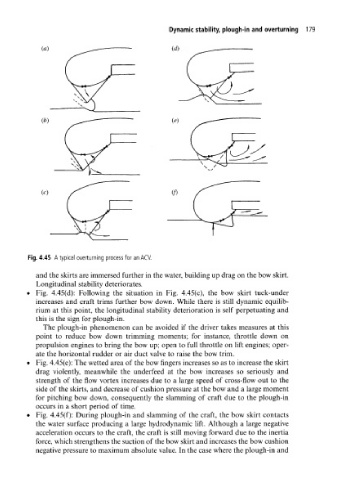
          Fig. 4.45  A typical overturning  process for  an ACV.

             and  the skirts are immersed further  in the water, building up drag on the bow skirt.
             Longitudinal  stability  deteriorates.
          •  Fig.  4.45(d):  Following  the  situation  in  Fig.  4.45(c),  the  bow  skirt  tuck-under
             increases  and  craft  trims further  bow  down.  While there  is still  dynamic  equilib-
             rium  at this point,  the longitudinal stability deterioration  is self  perpetuating  and
             this is the  sign for plough-in.
               The plough-in phenomenon  can  be  avoided  if  the  driver takes measures  at  this
             point  to  reduce  bow  down  trimming  moments;  for  instance,  throttle  down  on
             propulsion  engines to bring the bow up; open to  full  throttle  on  lift  engines;  oper-
             ate the horizontal rudder or air duct valve to raise the bow trim.
          •  Fig. 4.45(e): The wetted area of the bow fingers increases so as to increase the skirt
             drag  violently, meanwhile  the  underfeed  at  the  bow  increases  so  seriously  and
             strength  of  the flow vortex increases due  to  a large speed  of  cross-flow  out  to  the
             side of  the skirts, and  decrease of cushion pressure at the bow and  a large moment
             for  pitching bow  down, consequently the  slamming of  craft  due  to  the  plough-in
             occurs in a short period  of  time.
          •  Fig.  4.45(f): During plough-in and  slamming of  the craft,  the bow skirt contacts
             the  water surface producing  a  large hydrodynamic  lift.  Although  a  large  negative
             acceleration  occurs to  the craft,  the craft  is still moving forward  due to  the  inertia
             force,  which strengthens the suction of the bow skirt and  increases the bow cushion
             negative pressure to maximum absolute value. In the case where the plough-in and

