


Page 353 - Thermal Hydraulics Aspects of Liquid Metal Cooled Nuclear Reactors
P. 353
Core thermal hydraulics                                           319


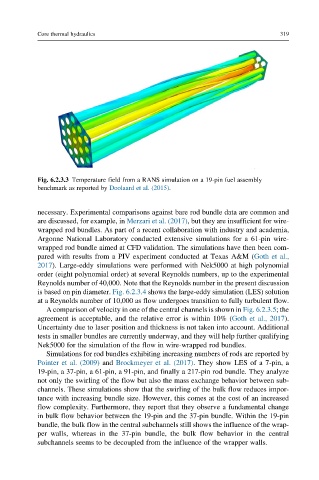
           Fig. 6.2.3.3 Temperature field from a RANS simulation on a 19-pin fuel assembly
           benchmark as reported by Doolaard et al. (2015).


           necessary. Experimental comparisons against bare rod bundle data are common and
           are discussed, for example, in Merzari et al. (2017), but they are insufficient for wire-
           wrapped rod bundles. As part of a recent collaboration with industry and academia,
           Argonne National Laboratory conducted extensive simulations for a 61-pin wire-
           wrapped rod bundle aimed at CFD validation. The simulations have then been com-
           pared with results from a PIV experiment conducted at Texas A&M (Goth et al.,
           2017). Large-eddy simulations were performed with Nek5000 at high polynomial
           order (eight polynomial order) at several Reynolds numbers, up to the experimental
           Reynolds number of 40,000. Note that the Reynolds number in the present discussion
           is based on pin diameter. Fig. 6.2.3.4 shows the large-eddy simulation (LES) solution
           at a Reynolds number of 10,000 as flow undergoes transition to fully turbulent flow.
              A comparison of velocity in one of the central channels is shown in Fig. 6.2.3.5; the
           agreement is acceptable, and the relative error is within 10% (Goth et al., 2017).
           Uncertainty due to laser position and thickness is not taken into account. Additional
           tests in smaller bundles are currently underway, and they will help further qualifying
           Nek5000 for the simulation of the flow in wire-wrapped rod bundles.
              Simulations for rod bundles exhibiting increasing numbers of rods are reported by
           Pointer et al. (2009) and Brockmeyer et al. (2017). They show LES of a 7-pin, a
           19-pin, a 37-pin, a 61-pin, a 91-pin, and finally a 217-pin rod bundle. They analyze
           not only the swirling of the flow but also the mass exchange behavior between sub-
           channels. These simulations show that the swirling of the bulk flow reduces impor-
           tance with increasing bundle size. However, this comes at the cost of an increased
           flow complexity. Furthermore, they report that they observe a fundamental change
           in bulk flow behavior between the 19-pin and the 37-pin bundle. Within the 19-pin
           bundle, the bulk flow in the central subchannels still shows the influence of the wrap-
           per walls, whereas in the 37-pin bundle, the bulk flow behavior in the central
           subchannels seems to be decoupled from the influence of the wrapper walls.

