


Page 358 - Thermal Hydraulics Aspects of Liquid Metal Cooled Nuclear Reactors
P. 358
324                   Thermal Hydraulics Aspects of Liquid Metal Cooled Nuclear Reactors


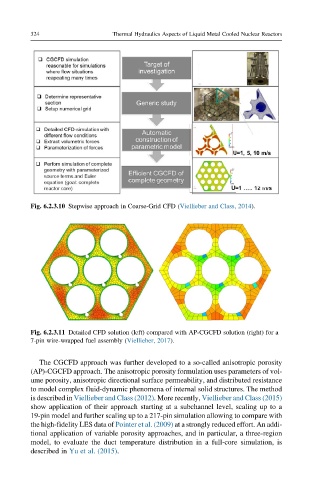
         Fig. 6.2.3.10 Stepwise approach in Coarse-Grid CFD (Viellieber and Class, 2014).


         Fig. 6.2.3.11 Detailed CFD solution (left) compared with AP-CGCFD solution (right) for a
         7-pin wire-wrapped fuel assembly (Viellieber, 2017).


            The CGCFD approach was further developed to a so-called anisotropic porosity
         (AP)-CGCFD approach. The anisotropic porosity formulation uses parameters of vol-
         ume porosity, anisotropic directional surface permeability, and distributed resistance
         to model complex fluid-dynamic phenomena of internal solid structures. The method
         is described in Viellieber and Class (2012). More recently, Viellieber and Class (2015)
         show application of their approach starting at a subchannel level, scaling up to a
         19-pin model and further scaling up to a 217-pin simulation allowing to compare with
         the high-fidelity LES data of Pointer et al. (2009) at a strongly reduced effort. An addi-
         tional application of variable porosity approaches, and in particular, a three-region
         model, to evaluate the duct temperature distribution in a full-core simulation, is
         described in Yu et al. (2015).

