


Page 360 - Thermal Hydraulics Aspects of Liquid Metal Cooled Nuclear Reactors
P. 360
326                   Thermal Hydraulics Aspects of Liquid Metal Cooled Nuclear Reactors


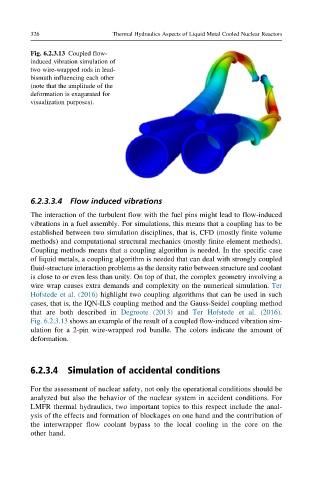
         Fig. 6.2.3.13 Coupled flow-
         induced vibration simulation of
         two wire-wrapped rods in lead-
         bismuth influencing each other
         (note that the amplitude of the
         deformation is exagarated for
         visualization purposes).


         6.2.3.3.4 Flow induced vibrations

         The interaction of the turbulent flow with the fuel pins might lead to flow-induced
         vibrations in a fuel assembly. For simulations, this means that a coupling has to be
         established between two simulation disciplines, that is, CFD (mostly finite volume
         methods) and computational structural mechanics (mostly finite element methods).
         Coupling methods means that a coupling algorithm is needed. In the specific case
         of liquid metals, a coupling algorithm is needed that can deal with strongly coupled
         fluid-structure interaction problems as the density ratio between structure and coolant
         is close to or even less than unity. On top of that, the complex geometry involving a
         wire wrap causes extra demands and complexity on the numerical simulation. Ter
         Hofstede et al. (2016) highlight two coupling algorithms that can be used in such
         cases, that is, the IQN-ILS coupling method and the Gauss-Seidel coupling method
         that are both described in Degroote (2013) and Ter Hofstede et al. (2016).
         Fig. 6.2.3.13 shows an example of the result of a coupled flow-induced vibration sim-
         ulation for a 2-pin wire-wrapped rod bundle. The colors indicate the amount of
         deformation.


         6.2.3.4   Simulation of accidental conditions

         For the assessment of nuclear safety, not only the operational conditions should be
         analyzed but also the behavior of the nuclear system in accident conditions. For
         LMFR thermal hydraulics, two important topics to this respect include the anal-
         ysis of the effects and formation of blockages on one hand and the contribution of
         the interwrapper flow coolant bypass to the local cooling in the core on the
         other hand.

