


Page 359 - Thermal Hydraulics Aspects of Liquid Metal Cooled Nuclear Reactors
P. 359
Core thermal hydraulics                                           325

           6.2.3.3.3 Deformations

           Most simulations that can be found in literature only consider as-designed geometries.
           However, from operating experience, it is known that deformations of the as-designed
           nondeformed fuel assemblies will occur, not only as a result of off-normal operation
           but also as a result of operational conditions and manufacturing accuracy. Such defor-
           mations can be due to effects of tension of prestressed wires, contact pressure between
           cladding and adjacent wires, thermal expansion, thermal and irradiation clad creep,
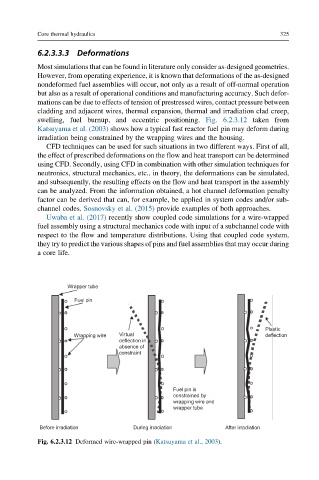
           swelling, fuel burnup, and eccentric positioning. Fig. 6.2.3.12 taken from
           Katsuyama et al. (2003) shows how a typical fast reactor fuel pin may deform during
           irradiation being constrained by the wrapping wires and the housing.
              CFD techniques can be used for such situations in two different ways. First of all,
           the effect of prescribed deformations on the flow and heat transport can be determined
           using CFD. Secondly, using CFD in combination with other simulation techniques for
           neutronics, structural mechanics, etc., in theory, the deformations can be simulated,
           and subsequently, the resulting effects on the flow and heat transport in the assembly
           can be analyzed. From the information obtained, a hot channel deformation penalty
           factor can be derived that can, for example, be applied in system codes and/or sub-
           channel codes. Sosnovsky et al. (2015) provide examples of both approaches.
              Uwaba et al. (2017) recently show coupled code simulations for a wire-wrapped
           fuel assembly using a structural mechanics code with input of a subchannel code with
           respect to the flow and temperature distributions. Using that coupled code system,
           they try to predict the various shapes of pins and fuel assemblies that may occur during
           a core life.


                   Wrapper tube
                     Fuel pin


                                                                         Plastic
                     Wrapping wire  Virtual                              deflection
                                 deflection in
                                 absence of
                                 constraint


                                                Fuel pin is
                                                constrained by
                                                wrapping wire and
                                                wrapper tube

            Before irradiation       During irradiation       After irradiation
           Fig. 6.2.3.12 Deformed wire-wrapped pin (Katsuyama et al., 2003).

