


Page 357 - Thermal Hydraulics Aspects of Liquid Metal Cooled Nuclear Reactors
P. 357
Core thermal hydraulics                                           323


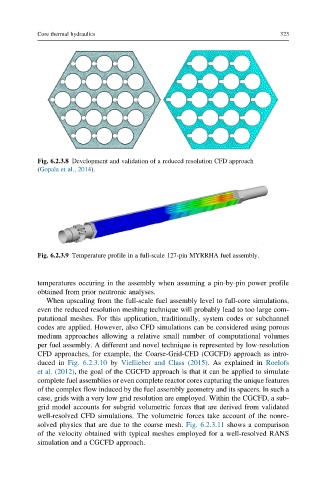
           Fig. 6.2.3.8 Development and validation of a reduced resolution CFD approach
           (Gopala et al., 2014).


           Fig. 6.2.3.9 Temperature profile in a full-scale 127-pin MYRRHA fuel assembly.


           temperatures occuring in the assembly when assuming a pin-by-pin power profile
           obtained from prior neutronic analyses.
              When upscaling from the full-scale fuel assembly level to full-core simulations,
           even the reduced resolution meshing technique will probably lead to too large com-
           putational meshes. For this application, traditionally, system codes or subchannel
           codes are applied. However, also CFD simulations can be considered using porous
           medium approaches allowing a relative small number of computational volumes
           per fuel assembly. A different and novel technique is represented by low-resolution
           CFD approaches, for example, the Coarse-Grid-CFD (CGCFD) approach as intro-
           duced in Fig. 6.2.3.10 by Viellieber and Class (2015). As explained in Roelofs
           et al. (2012), the goal of the CGCFD approach is that it can be applied to simulate
           complete fuel assemblies or even complete reactor cores capturing the unique features
           of the complex flow induced by the fuel assembly geometry and its spacers. In such a
           case, grids with a very low grid resolution are employed. Within the CGCFD, a sub-
           grid model accounts for subgrid volumetric forces that are derived from validated
           well-resolved CFD simulations. The volumetric forces take account of the nonre-
           solved physics that are due to the coarse mesh. Fig. 6.2.3.11 shows a comparison
           of the velocity obtained with typical meshes employed for a well-resolved RANS
           simulation and a CGCFD approach.

