


Page 348 - Bird R.B. Transport phenomena
P. 348
332  Chapter  10  Shell Energy Balances and Temperature Distributions in Solids and Laminar Flow

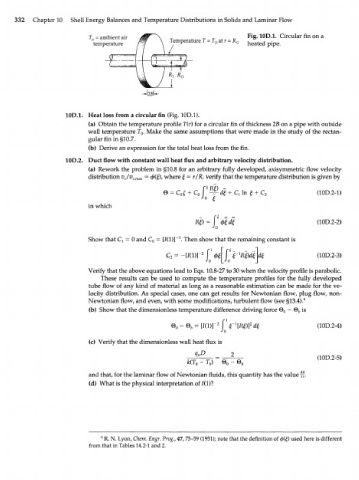
                           T  = ambient air                               Fig. 10D.1.  Circular fin on a
                             a
                             temperature           Temperature T = T  at r = R  0
                                                                 o
                                                   /


                     10D.1.  Heat loss from a circular fin (Fig. 10D.1).
                           (a)  Obtain the temperature profile T(r) for a circular fin  of thickness IB on a pipe with outside
                           wall temperature  T . Make the same assumptions that were made in the study  of the rectan-
                                           o
                           gular  fin in §10.7.
                           (b)  Derive an expression for the total heat loss from the  fin.
                     10D.2.  Duct flow with constant wall heat flux and  arbitrary velocity distribution.
                           (a)  Rework the problem in §10.8 for  an arbitrary fully  developed, axisymmetric flow velocity
                           distribution v /v zmax  = ф(£), where f  = r/R.  verify that the temperature distribution is given by
                                      z
                                                                                              (10D.2-1)

                           in which
                                                           1(0 =                              (10D.2-2)

                                                      1
                           Show that Q  = 0 and  C o =  [/(I)]" . Then show that the remaining constant is
                                                            2
                                                  c  =  -umv                                  (10D.2-3)
                                                   2
                           Verify that the above equations lead to Eqs. 10.8-27 to 30 when the velocity profile is parabolic.
                               These  results  can  be used  to  compute  the temperature  profiles  for  the  fully  developed
                           tube flow  of any kind  of material as long as a reasonable estimation  can be made  for the ve-
                           locity distribution. As special cases, one can get results  for Newtonian flow, plug flow, non-
                           Newtonian flow, and even, with some modifications, turbulent flow (see §13.4). 6
                           (b)  Show that the dimensionless temperature difference  driving force  @ 0 -  S b  is

                                                                                              (10D.2-4)

                           (c)  Verify that the dimensionless wall heat flux is

                                                                                              (10D.2-5)
                                                            -  T b)  0 O -
                                                        k(T 0         ® b
                           and that, for the laminar flow of Newtonian fluids, this quantity has the value  ff.
                           (d)  What is the physical interpretation  of Д1)?


                               6  R. N. Lyon, Chem. Engr. Prog., 47, 75-59 (1951); note that the definition  of ф{£) used here is different
                           from that in Tables 14.2-1 and 2.

