


Page 476 - Bird R.B. Transport phenomena
P. 476
456   Chapter  15  Macroscopic Balances for Nonisothermal Systems

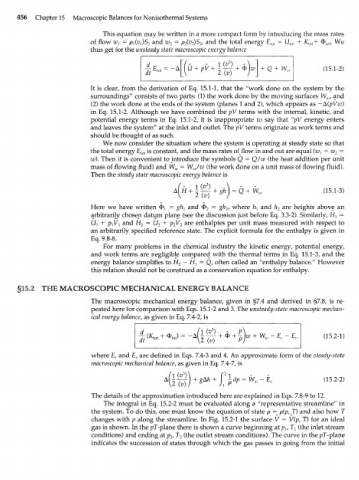
                               This equation may  be written in  a more compact form by introducing the mass rates
                            of  flow  w-i =  p-iiv^S-i and  w 2  = p 2(v 2)S 2/  and  the  total energy £ tot  =  L/ tot  +  X tot+  Ф .  We
                                                                                                 1о1
                            thus get  for  the unsteady state macroscopic energy balance
                                                                          i  1
                                                                                                (15.1-2)


                            It  is  clear,  from  the derivation  of  Eq.  15.1-1, that  the  "work  done  on  the  system  by  the
                            surroundings"  consists  of  two  parts:  (1) the work  done by  the moving  surfaces  W , and
                                                                                                 n!
                            (2) the work  done at the ends  of  the system  (planes  1 and  2), which  appears  as  — \{pVw)
                            in  Eq.  15.1-2.  Although  we  have  combined  the pV  terms  with  the  internal, kinetic,  and
                            potential  energy  terms  in  Eq.  15.1-2,  it  is  inappropriate  to  say  that  "pV  energy  enters
                            and leaves the system"  at the inlet and outlet. The pV  terms  originate  as work  terms  and
                            should  be thought of as  such.
                               We  now  consider  the situation where  the system  is  operating  at steady  state  so  that
                            the total energy  E  is constant, and the mass  rates  ofjflow  in and out are equal  (w ]  = w 2  =
                                           tot
                            w). Then it  is  convenient  to introduce the symbols  Q  =  Q/zv  (the heat addition  per  unit
                            mass  of  flowing  fluid)  and  W  = W /w  (the work  done on a unit mass  of  flowing  fluid).
                                                     m    nl
                            Then the steady  state  macroscopic energy  balance is
                                                                     = Q+W  M I                 (15.1-3)

                            Here  we  have  written  Ф г  =  gh^ and  Ф 2  =  gh ,  where  h A  and  h 2  are  heights  above  an
                                                                   2
                            arbitrarily  chosen datum plane  (see  the discussion  just before  Eq. 3.3-2).  Similarly,  H A  =
                            Ui  +  piVi  and  H 2  =  U 2  + p V 2  a r e  enthalpies  per  unit  mass  measured  with  respect  to
                                                    2
                            an  arbitrarily  specified  reference  state. The explicit  formula  for  the enthalpy  is  given  in
                            Eq.  9.8-8.
                                For  many  problems  in  the  chemical  industry  the  kinetic  energy,  potential  energy,
                            and  work  terms  are  negligible  compared  with  the  thermal  terms  in  Eq.  15.1-3, and  the
                            energy  balance  simplifies  to H 2  — Щ  =  Q,  often  called  an  "enthalpy  balance."  However
                            this relation should  not be construed  as a conservation  equation  for  enthalpy.

      §15.2   THE MACROSCOPIC MECHANICAL ENERGY                 BALANCE

                            The  macroscopic  mechanical  energy  balance,  given  in  §7.4  and  derived  in  §7.8,  is  re-
                            peated  here for  comparison  with  Eqs. 15.1-2 and  3. The unsteady-state macroscopic mechan-
                            ical energy balance, as given in Eq. 7.4-2, is

                                                                                                (15.2-1)

                            where  E  and  E  are  defined  in  Eqs.  7.4-3  and  4. An  approximate  form  of  the steady- i-state
                                   c
                                         v
                            macroscopic mechanical  balance, as  given  in  Eq, 7.4-7, is
                                                 A        + g A h +  Av=                       a5
                                                     f
                                                  (l t)          Г ™-'"        ^
                                                                    \
                            The details  of  the approximation  introduced here are explained  in Eqs.  7.8-9  to 12.
                                The integral  in  Eq.  15.2-2 must  be  evaluated  along  a  "representative  streamline"  in
                            the system.  To do  this, one must  know  the equation  of  state  p  = pip,J)  and  also  how T
                            changes  with  p  along  the  streamline.  In Fig.  15.2-1  the  surface  V  =  V(p,  T) for  an  ideal
                            gas  is  shown.  In the /?T-plane there is shown  a curve  beginning  at p ,  T x  (the inlet  stream
                                                                                     x
                            conditions) and ending  at p ,  T  (the outlet stream  conditions). The curve  in the pT-plane
                                                   2
                                                      2
                            indicates  the succession  of  states  through  which  the gas  passes  in  going  from  the  initial

