


Page 678 - Bird R.B. Transport phenomena
P. 678
658  Chapter 21  Concentration Distributions  in Turbulent  Flow

                            times.  In tube  flow  with  mass  transfer  at  the  wall,  one  expects  that  the  time-smoothed
                            concentration  c A  will  vary  only  slightly  with  position  in  the  turbulent  core,  where  the
                            transport by  turbulent eddies  predominates. In the slowly moving  region  near the bound-
                            ary  surface,  on  the other  hand, the concentration c A  will  be  expected  to change  within  a
                            small  distance  from  its  turbulent-core  value  to  the  wall  value.  The  steep  concentration
                            gradient  is  then associated  with  the slow  molecular  diffusion  process  in  the viscous  sub-
                            layer  in contrast to the rapid  eddy  transport in the turbulent core.


       §21.2  TIME-SMOOTHING        OF  THE  EQUATION
              OF  CONTINUITY     OF  A

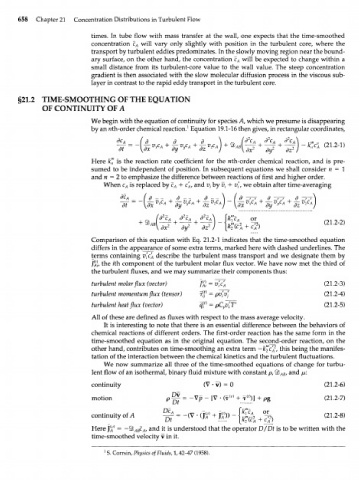
                            We  begin  with  the equation  of continuity  for  species  A, which we  presume  is  disappearing
                                                        1
                            by  an j?th-order chemical reaction.  Equation 19.1-16 then gives, in rectangular  coordinates,


                            Here  k'" is  the  reaction  rate  coefficient  for  the  Hth-order chemical  reaction, and  is  pre-
                            sumed  to be  independent  of  position.  In subsequent  equations  we  shall  consider  n  = 1
                            and  n  = 2 to emphasize  the difference  between  reactions  of  first  and higher  order.
                                When  c A  is replaced  by  c A  + c , and  by  v t  + v\, we  obtain after  time-averaging
                                                              v
                                                        A
                                                               s
                                    д                                      r  r     T  r
                                     ^А _(д_--     + A - -  + sL~c  \  -  (—~ ~  + -^L~ ~  +  A ~
                                       =
                                                                                 V A
                                                                         '
                                     dt    \dx  VXCA  dy Vy  A  dz  z  A )  \dx  VX CA  dy ^  dz  Vz
                                                                                                (21.2-2)
                            Comparison  of  this  equation  with  Eq.  21.2-1  indicates  that  the  time-smoothed  equation
                            differs  in the appearance  of  some  extra  terms, marked  here with  dashed  underlines. The
                            terms  containing  v\c A  describe  the  turbulent  mass  transport  and  we  designate  them  by
                            f ,  the  ith  component  of  the turbulent  molar  flux  vector.  We  have  now  met  the third  of
                             Ai
                            the  turbulent  fluxes, and we  may  summarize  their components thus:
                            turbulent molar flux  (vector)  ]% = v\c A                           (21.2-3)
                            turbulent  momentum  flux  (tensor)  т]- = pv'iV-                    (21.2-4)
                                                              ]
                            turbulent heat flux  (vector)   q) n  = pC vjT                       (21.2-5)
                                                                   p
                            All  of  these are defined  as  fluxes  with  respect  to the mass  average  velocity.
                                It  is  interesting  to note that there is  an essential  difference  between  the behaviors  of
                            chemical  reactions  of  different  orders.  The  first-order  reaction  has  the same  form  in  the
                            time-smoothed  equation  as  in  the  original  equation.  The  second-order  reaction, on  the
                                                                                   2
                            other hand, contributes  on time-smoothing  an  extra  term  — /C'"Q, this being  the  manifes-
                                                                                 2
                            tation  of  the interaction between  the chemical  kinetics  and the turbulent  fluctuations.
                                We  now  summarize  all  three  of  the  time-smoothed  equations  of  change  for  turbu-
                            lent flow  of an isothermal, binary  fluid  mixture  with  constant p, 4b , and fi\
                                                                                    AB
                            continuity                       (V  •  v)  = 0                       (21.2-6)
                                                                          (n
                                                                    (
                            motion                p j£  = Vp  -  [V  • (т '°  + T )]  + pg       (21.2-7)
                                                         -
                                                                          С
                            continuity  of  A    -=£  =  -(V  • (Jjj 0  4- J^))  -  \ Л, А  %    (21.2-8)
                                                  L/t                  I fc~> \C A  i  С А  )
                            Here f A  =  ~4b c  and  it  is understood  that the operator  D/Dt  is  to be  written  with  the
                                         AB Af
                            time-smoothed  velocity  v  in it.
                                1
                                 S. Corrsin, Physics of Fluids, 1,42-47  (1958).

