


Page 680 - Bird R.B. Transport phenomena
P. 680
660  Chapter 21  Concentration Distributions in Turbulent Flow

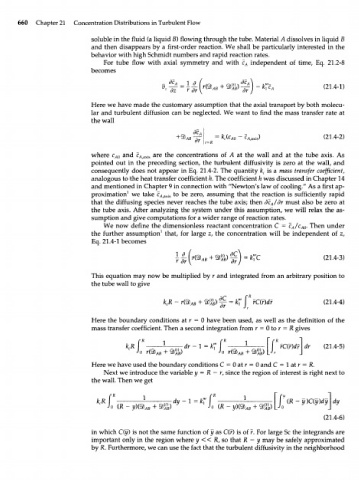
                            soluble  in the  fluid  (a liquid  B) flowing through the tube. Material A dissolves in liquid В
                            and  then disappears  by  a  first-order  reaction. We  shall  be  particularly  interested  in  the
                            behavior  with  high Schmidt numbers and rapid  reaction rates.
                                For  tube  flow  with  axial  symmetry  and  with  c A  independent  of  time,  Eq.  21.2-8
                            becomes

                                                                             •k"'c A            (21.4-1)


                            Here we  have  made the customary  assumption  that the axial  transport by  both  molecu-
                            lar  and  turbulent  diffusion  can be  neglected.  We  want  to  find  the mass  transfer  rate  at
                            the  wall
                                                                             )                  (21.4-2)


                            where  c A0  and  c A axi s  are  the  concentrations  of  A  at  the  wall  and  at  the  tube  axis.  As
                            pointed  out  in  the  preceding  section,  the  turbulent  diffusivity  is  zero  at  the wall, and
                            consequently  does  not appear  in  Eq. 21.4-2.  The quantity  k c  is  a  mass transfer coefficient,
                            analogous  to the heat transfer  coefficient  h. The coefficient  h was  discussed  in Chapter 14
                            and  mentioned in Chapter 9 in connection with  "Newton's law  of cooling."  As  a first ap-
                            proximation 1  we  take  с  л axi s  to  be  zero, assuming  that  the  reaction  is  sufficiently  rapid
                            that  the diffusing  species  never  reaches  the  tube  axis;  then dcjdr  must  also  be  zero  at
                            the  tube  axis.  After  analyzing  the  system  under  this  assumption,  we  will  relax  the  as-
                            sumption and give computations for  a wider  range  of reaction rates.
                                We  now  define  the dimensionless  reactant concentration С  = c /c .  Then under
                                                                                       A
                                                                                         A0
                            the  further  assumption  1  that,  for  large  z,  the  concentration will  be  independent  of  z,
                            Eq.  21.4-1  becomes
                                                                             :                  (21.4-3)

                            This  equation  may  now  be  multiplied  by  r and  integrated  from  an arbitrary  position  to
                            the  tube wall to give
                                                                  ас     f  R
                                                                           rC(r)dr              (21.4-4)

                            Here  the boundary  conditions  at  r  =  0 have  been  used,  as  well  as  the definition  of  the
                            mass  transfer  coefficient.  Then a second integration from  r  = 0 to r  = R gives

                                      k R  Г         — dr-\  = к"' Г     -   —   Г  гСШг   dr   (21.4-5)
                                       c
                            Here we  have used  the boundary conditions С = 0 at r = 0 and С = 1 at r  = R.
                                Next we  introduce the variable  у  = R  — r, since the region  of  interest  is right  next to
                            the  wall. Then we  get


                              k R  Г       -     -—dy-   1 =k"' \ R      1     —   [ У  (R-y)C(y)dy\dy
                               c
                                                                                   J
                                 h  (R -  y№ AB  + Э<&)  ^    J o  (R -  у)(Э л в  + S O L o  У  У  У  ]  У
                                                                                                (21.4-6)
                            in  which  C(y) is  not the same  function  of  у  as  C(r) is  of  r. For large  Sc the integrands  are
                            important  only  in  the region  where  у  «  R, so  that R  — у  may  be  safely  approximated
                            by  K. Furthermore, we  can use the fact  that the turbulent diffusivity  in the neighborhood

