


Page 684 - Bird R.B. Transport phenomena
P. 684
664  Chapter 21  Concentration Distributions in Turbulent Flow

                           Then both Eqs. 21.5-1 and 2 take the following  form  over  the whole  system:

                                                                                                (21.5-8)

                           Here the subscript  i can represent either solute A  or solute  B, and

                                               Г  = 0 for  (a) the entering Л-rich stream, or
                                                       (b) initially Л-rich region              (21.5-9)
                                               Г  = 1 for  (a) the entering  B-rich stream, or
                                                       (b) initially  B-rich region            (21.5-10)
                           It  follows  that,  for  equal  diffusivities,  the  time-smoothed  concentration  profiles,
                           Г(х, у, z, t) are identical for both solutes, where
                                                         p  _  C A0  C                         (21.5-11)
                                                                      c
                                                                      B0
                           However,  the fluctuating  quantities Г'  are also  of  interest, as  they  are measures  of  "un-
                           mixedness."  These can be equal only  in a statistical  sense. To show  this, we  subtract Eq.
                           21.5-11  from  Eq. 21.5-7, and then square the result and time-smooth it to give

                                                                                               (21.5-12)

                           Here d(x, y, z, t) is a dimensionless decay function, which decreases toward zero at large z
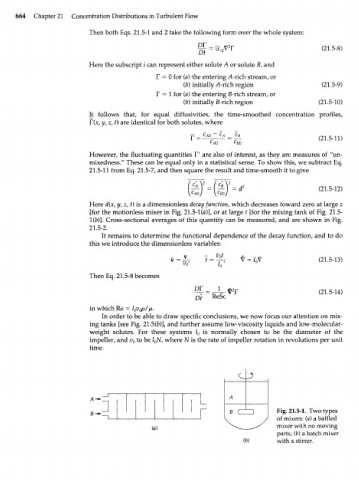
                            [for  the motionless mixer  in Fig. 21.5-1 (я)], or at large  t  [for  the mixing  tank  of  Fig. 21.5-
                            l(b)]. Cross-sectional  averages  of  this quantity  can be  measured, and  are shown  in  Fig.
                           21.5-2.
                               It remains to determine the functional  dependence of  the decay  function, and  to do
                            this we  introduce the dimensionless  variables:
                                                                 v t                           (21.5-13)
                                                                 o

                            Then  Eq. 21.5-8 becomes
                                                          Р Г _  1  ,                          (21.5-14)
                                                          Dt    R e S c
                            in which  Re = v p//Ji.
                                        l
                                         o o
                               In order to be able to draw  specific  conclusions, we  now  focus  our attention on mix-
                            ing tanks  [see  Fig. 21.5(b)], and further  assume low-viscosity liquids  and  low-molecular-
                            weight  solutes.  For  these  systems  /  is  normally  chosen  to  be  the  diameter  of  the
                                                           0
                            impeller, and v 0  to be 1 N, where N is the rate of  impeller rotation in revolutions per unit
                                               O
                            time.


                                                           L
                            A-+-
                                                           Г                      Fig.  21.5-1.  Two  types
                            B-+-                                                  of mixers:  (я) a  baffled
                                                                                  mixer with no moving
                                              (a)
                                                                                  parts; (b) a batch mixer
                                                                         (6)      with a stirrer.

