


Page 681 - Bird R.B. Transport phenomena
P. 681
§21.4  Enhancement of Mass Transfer by a First-Order Reaction in Turbulent Flow  661

                 of the wall  is proportional to the third power  of the distance from  the wall.  When  the in-
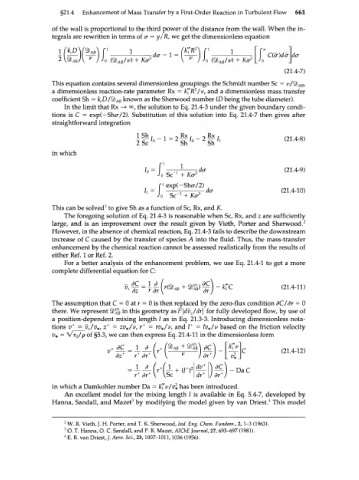
                 tegrals are rewritten in terms of  <x = y/'R, we get the dimensionless equation


                                                             J
                                  (a> AB /v)  +  Ko*  V  V  I o  <Sb AB /v)  +  K0 3
                                                                                     (21.4-7)
                 This equation contains several  dimensionless groupings:  the Schmidt number Sc = v/%b ,
                                                                                         AB
                                                           2
                 a  dimensionless  reaction-rate parameter Rx = /с"'К /^, and a dimensionless  mass  transfer
                 coefficient  Sh = k D/4b  known as the Sherwood number (D being  the tube diameter).
                               c   AB
                    In the limit that Rx —> <», the solution to Eq. 21.4-3 under the given  boundary condi-
                 tions  is С = exp(—Shcr/2). Substitution  of this  solution  into Eq. 21.4-7  then gives  after
                 straightforward  integration
                                         1^^-1=2^/0-2^/!                             (21.4-8)

                 in  which
                                                      1
                                                     1
                                             • - / : о Sc"  + Ко 3 do-               (21.4-9)
                                                fi  exp(-Sho-/2)
                                            J,=   — — .     da                     (21.4-10)
                                                      1
                                               Jo  Sc"  + Ко r 3
                 This can be solved 1  to give Sh as a function  of Sc, Rx, and K.
                    The foregoing  solution of Eq. 21.4-3 is reasonable when  Sc, Rx, and z are  sufficiently
                 large,  and is an improvement  over  the result  given  by  Vieth,  Porter and Sherwood. 2
                 However, in the absence of chemical reaction, Eq. 21.4-3 fails to describe the downstream
                 increase  of С caused  by the transfer  of species  A  into the fluid.  Thus, the mass-transfer
                 enhancement by the chemical reaction cannot be assessed  realistically  from the results of
                 either  Ref. 1 or Ref. 2.
                    For  a better  analysis  of the enhancement problem, we use Eq. 21.4-1  to get a more
                 complete differential  equation for C:
                                                                    k
                                                             %)
                                              =
                                      °* f  Hr     { r&AB +  ®  f f )  - "' C
                 The assumption that С = 0 at r = 0 is then replaced by the zero-flux  condition дС/дг  =  О
                                                      2
                 there. We represent 4b% in this geometry as I \dv,/dr\  for fully  developed  flow, by use of
                 a  position-dependent mixing  length  / as in Eq. 21.3-3. Introducing dimensionless  nota-
                 tions  v +  = v /v*, z +  = zv*/v,  r +  = Wtlv,  and Г  = lv*/v  based  on the friction  velocity
                           2
                 v* = Vr /p  of §5.3, we can then express  Eq. 21.4-11 in the dimensionless  form
                       o
                                   SC _ 1 д (  /Эдв + Эй. < ? с \ Г
                                                 +                                  (21.4-12)


                                         r +  dr +         dr +
                 in which a Damkohler number Da = k'"v/vl  has been introduced.
                    An  excellent  model  for the mixing  length  / is available  in Eq. 5.4-7,  developed  by
                 Hanna,  Sandall, and Mazet  by modifying  the model  given  by van Driest. 4  This  model
                                        3

                      W. R. Vieth,  J. H. Porter, and T. K. Sherwood,  Ind. Eng. Chem. Fundam.,  2,1-3  (1963).
                    2
                    3
                      О. Т. Hanna, О. С  Sandall, and P. R. Mazet, AIChE  Journal, 27, 693-697  (1981).
                     E. R. van Driest, /. Aero. Sci., 23,1007-1011,1036  (1956).
                    4

