


Page 682 - Bird R.B. Transport phenomena
P. 682
662  Chapter 21  Concentration Distributions in Turbulent Flow

                            will  give  smooth  concentration profiles,  provided  that we  use  a  velocity  function  with
                            continuous  radial derivative,  rather than the piecewise  continuous expressions  given  in
                            Fig.  5.5-3. Such a function is obtainable by  integrating the differential  equation

                                                                                                (21.4-13)
                                                    dy
                             in  the dimensionless  variables  v +  = vjv*  and y +  = yv*/v  of  Fig. 5.5-3, with  the bound-
                                                                      +
                            ary  conditions v +  = 0 at  \f = 0 (the wall)  and  dv  /dy +  = 0 at y +  = R +  (the centerline).
                             Equation  21.4-13  is obtained  (see Problem 21B.5) by  combining the cylindrical-coordinate
                            versions  of  Eqs. 5.5-3 and 5.4-4 with the dimensionless  form
                                                            -  exp(-y726)
                                                                           forO  :              (21.4-14)
                                                         Vl  -  exp(-0.26y )
                                                                        +
                            of  the mixing-length  model shown  in Eq. 5.4-7.  Equation 21.4-13  is  solvable  via  the qua-
                            dratic formula  to give
                                                    -1  + Vl                     +
                                                                              ify >0;           (21.4-15)
                                                                                 +
                                                    1                         ify  =0
                             and  v +  is then computable by quadrature using, for  example, the subroutines trapzd and
                            qtrap  of  Press  et al.  The resulting  v +  function  closely  resembles  the plotted line  in  Fig.
                                             5
                             5.5-3, with  small  changes  near y +  =  30 where  the plotted line has  a slope  discontinuity,
                             and  near  the centerline where  the calculated  v +  function  attains  a maximum  value  de-
                             pendent  on  the dimensionless  wall  radius  R +  whereas  the line  in  Fig.  5.5-3  improperly
                             does not.
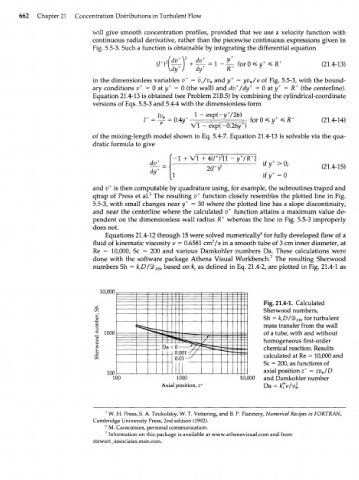
                                Equations  21.4-12  through  15 were  solved  numerically 6  for  fully  developed  flow  of a
                                                                2
                             fluid  of  kinematic viscosity  v  = 0.6581  cm /s  in a smooth tube of  3 cm inner diameter, at
                             Re  =  10,000,  Sc  =  200  and  various  Damkohler numbers  Da. These  calculations  were
                             done  with  the  software  package  Athena  Visual  Workbench. 7  The  resulting  Sherwood
                             numbers  Sh  = k D/4b ABf  based  on k  as  defined  in  Eq. 21.4-2, are plotted in Fig. 21.4-1  as
                                                          c
                                          c

                               10,000
                                                                               Fig.  21.4-1. Calculated
                                                                               Sherwood numbers,
                                                                               Sh  = k D/4b , for turbulent
                                                                                    c
                                                                                        AB
                                                                               mass transfer  from the wall
                                1000  -            •а.  - 9 Ва •               of a tube, with and without
                                                   Щ
                                                     ^ 1                       homogeneous  first-order
                                                 Da  = 1 J -          S B      chemical reaction. Results
                                                     ).С                       calculated at Re = 10,000 and
                                                     (
                                                     ( З.С I \-^               Sc = 200, as functions  of
                                 100                                           axial position z  +  = zv*/D
                                  100                1000               10,000  and  Damkohler number
                                                 Axial  position, z  +         Da  = U"vlvl.


                                5
                                  W. H. Press, S. A. Teukolsky,  W. T. Vettering, and B. P. Flannery, Numerical Recipes in FORTRAN,
                             Cambridge University  Press, 2nd edition (1992).
                                r
                                ' M. Caracotsios, personal communication.
                                7
                                 Information on this package  is available  at www.athenavisual.com  and from
                             stewartassociates.msn.com.

