


Page 686 - Bird R.B. Transport phenomena
P. 686
666  Chapter 21  Concentration Distributions in Turbulent Flow

                           many  different  mixer  geometries,  that the product of the required  mixing  time f mix  and
                           rotation rate N is a constant independent of mixer  size and Reynolds number:
                                                 M    = K(geometry)  or  t  =  K/N              (21.5-16)
                                                   m i x                mix
                           That  is, the  required  mixing  time t mix  corresponds, for a given  tank  geometry,  essen-
                           tially  to the required  number of turns of the impeller.  This  expectation is confirmed by
                           experience.
                               This  finding  is consistent  with  observations 2  that  both  the  dimensionless  volume
                                                            3
                                                                                            5
                                                                                           3
                           flow  rate  through  the  impeller,  Q/ND ,  and  the  tank  friction  factor,  P/pN D ,  are  con-
                           stants, depending  only  on the tank and  impeller  geometries  (see Problem  6C.3). Here Q
                           is the volumetric  flow  in the jet produced by the impeller, and P is the power  required to
                           turn it.
                               Similar  remarks  usually  apply  to motionless  mixers,  where  increasing  the  flow  ve-
                           locities  typically  has  little  effect  on the degree  of mixing.  However,  approximations  like
                            this must be tested, and such  tests should  be considered as first  steps  in an experimental
                           program.  As a  practical  matter,  these  approximations  are almost  always  reliable on
                           scale-up, since Reynolds numbers normally increase with  equipment  size.


      Reaction Occurring
                           We  next  consider  the  effects  of a homogeneous, irreversible  chemical  reaction, and for
                            simplicity  we  write  this as A + В -> products. Again  we  assume  dilute solutions, so that
                           the  heat of reaction and  the presence  of reaction products  have  no  significant  effect.  In
                           addition, we  assume  equal diffusivities  for  the two  solutes.
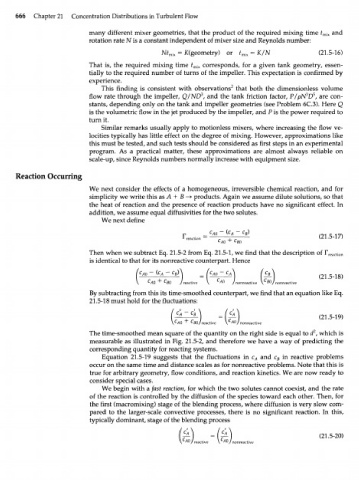
                               We  next  define
                                                       г   .  = <мо ~ fc'A ~ c )
                                                       1                  B
                                                        reaction    i                          \£l.D  I/)
                                                                 r C  r C
                                                                  A0  ^  B0
                           Then  when  we  subtract  Eq.  21.5-2  from  Eq. 21.5-1, we  find  that  the description  of r reaction
                            is identical  to that  for  its nonreactive  counterpart.  Hence
                                            o-(c A-c B)\    _fc AQ-c A\      (c B
                                             c Ao +    reactive  \  A( >  /nonreactive  \  йи /nonreactive
                            By subtracting  from  this its time-smoothed counterpart, we  find  that an equation like Eq.
                            21.5-18 must hold  for  the fluctuations:


                                                    C    C          C
                                                     A0  + B0/ reactive  \ Ao)  nonreactive
                                                                                             2
                            The time-smoothed mean square of the quantity on the right  side is equal  to d , which is
                            measurable as illustrated  in Fig.  21.5-2, and  therefore we have  a way  of predicting  the
                            corresponding quantity  for  reacting  systems.
                               Equation  21.5-19  suggests  that  the  fluctuations  in c  and  c  in reactive  problems
                                                                            A
                                                                                   B
                            occur on the same time and distance scales as for  nonreactive problems. Note that this is
                            true  for  arbitrary  geometry,  flow  conditions, and  reaction kinetics.  We  are now  ready to
                            consider special  cases.
                               We  begin  with a fast  reaction, for which  the two  solutes  cannot coexist,  and  the rate
                            of  the reaction is controlled by the diffusion  of the species  toward  each other. Then, for
                            the  first  (macromixing)  stage  of the blending  process, where  diffusion  is very  slow com-
                            pared  to the  larger-scale  convective  processes,  there is no  significant  reaction. In this,
                            typically  dominant, stage  of the blending  process

                                                       С А \    _ ( C A
                                                       с  l      \c  !                         (21.5-20)
                                                       C A0  /rpartivP  \ A0  nonreactive
                                                                  L

