


Page 689 - Bird R.B. Transport phenomena
P. 689
Problems  669

                           (b)  Next use the equation  of continuity  for species  A to obtain

                                                                                              (21B.2-2)
                                                                  Sc ((
                                    (0
                                         {t)
                           in which Sc  = /x /рЯЬ%. This equation  is to be integrated  with  the boundary  conditions that
                           U  is finite  at £ = 0 and dU x/d^  = 1 at f  =  \.
                                                       -
                            K
                           (c)  Integrate once with respect to f to obtain
                                                                 1/2
                                                                   (v /{v )№
                                                                        z
                                                                     z
                                                                                              (21B.2-3)
                                                          fll
                                                                       1
                    21B.3.  An  asymptotic expression for  the  turbulent mass flux.  Start with  the final  result  of Problem
                           21B.2, and note that for  sufficiently  high  Sc all curvature  of the concentration profile  will take
                           place very  near the wall, where /(v )  «  0 and £ «  \. Assume  that  Sc (/)  =  1 and  use  Eq.  5.4-2
                                                    v
                                                        z
                                                     z
                           to  obtain
                                                                                              (21B.3-1)
                                                            (0
                                                         Sc(/i /At)]
                                                       1/3
                           Introduce  the new coordinate  rj = Sc (yi;*/14.5i>)  into Eq. 21B.3-1 to get an equation  for  dU/dr)
                           valid  within  the laminar  sublayer.  Then integrate  from  17 =  0 (where  а>  = ы )  to  17 = °°  (where
                                                                                  л
                                                                                      А0
                           а> л  ~  а) ) to obtain an explicit  relation  for  the wall mass  flux  j . Compare with  the analog  of
                                 л/7
                                                                            A 0
                           Eq.  13.4-20 obtained in Problem 21 A.2.
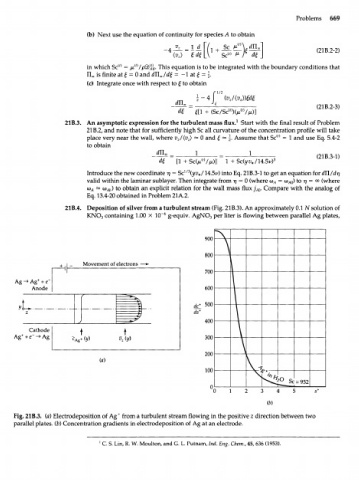
                    21B.4.  Deposition of silver from a turbulent stream (Fig. 21B.3). An approximately  0.1 N solution of
                           KNO3 containing  1.00  X 10" 6  g-equiv.  AgNO 3  per liter is flowing  between  parallel  Ag  plates,
                                                             900
                                                             800
                          Movement of  electrons
                                                             700
      Ag  -> Ag +  + e
           Anode                                             600

                                                             500
                                                          ds +
                                                             400
          Cathode
     Ag +  + e~ —> Ag                                        300       \

                                                             200       \
                              (a)
                                                             100
                                                                                   > о  Sc = 952
                                                               л                   •  •  —  —
                                                               °0   1i   : >  3   L1   5      s +
                                                                                (b)

     Fig.  21B.3.  (a)  Electrodeposition of Ag +  from  a turbulent stream flowing  in the positive  z direction between  two
     parallel plates, (b) Concentration gradients  in electrodeposition  of  Ag  at an electrode.


                              1
                                С  S. Lin,  R. W.  Moulton, and  G.  L. Putnam, Ind. Eng. Chetn., 45, 636  (1953).

