


Page 692 - Bird R.B. Transport phenomena
P. 692
672   Chapter 22  Interphase Transport in Nonisothermal Mixtures

                           Schmidt numbers  for  a number  of  relatively  simple  systems.  We  emphasize the  different
                           behavior  of systems  with  fluid-fluid  and solid-fluid  interfaces.
                               In  §22.3 we  show  how  dimensional analysis  leads  to predictions involving  the Sher-
                           wood  number  (Sh) and  the Schmidt number  (Sc), which  are  the analogs  of  the  Nusselt
                           number  (Nu) and  the Prandtl number  (Pr) defined  in Chapter  14. Here the emphasis  is
                           on  the analogies  between  heat  transfer  in pure  fluids  and  mass  transfer  in binary  mix-
                           tures. Then in §22.4 we  proceed to the definition  of mass  transfer  coefficients  for  systems
                           with  diffusion  in  two  adjoining  phases.  We  show  there how  to apply  the  information
                           about mass  transfer  in single  phases  to the understanding  of  mass  transfer  between  two
                           phases.
                               Finally, in the last  five sections  of the chapter, we  take up some  effects  that are pecu-
                           liar  to mass  transfer  systems:  mass  transfer  with  chemical  reactions  (§22.5), the interac-
                           tion  of  heat  and  mass  transfer  processes  in  free  convection  (§22.6),  the  complicating
                           factors  of  interfacial  tension  forces  and Marangoni  effects  (§22.7), the distortions  of  tem-
                           perature  and  concentration profiles  that  arise  in  systems  with  large  net  mass  transfer
                           rates across  the interface  (§22.8); and finally  the matrix analysis  of mass transport in mul-
                           ticomponent systems.  In this  chapter the emphasis  is  on the non-analogous behavior  of
                           heat and mass  transfer  systems.
                               In  this chapter we  have  limited  the discussion  to a  few  key  topics  on mass  transfer
                           and  transfer  coefficient  correlations. Further  information  is  available  in specialized  text-
                                                       1 4
                           books  on these and related topics. "

     §22.1   DEFINITION    OF TRANSFER     COEFFICIENTS     IN ONE   PHASE
                           In  this  chapter we  relate  the rates  of  mass  transfer  across  phase  boundaries  to the rele-
                           vant concentration differences,  mainly  for binary  systems.  These relations are  analogous
                           to  the  heat  transfer  correlations  of  Chapter  14  and  contain  mass  transfer coefficients in
                           place  of  the heat transfer  coefficients  of  that chapter. The system  may  have  a true  phase
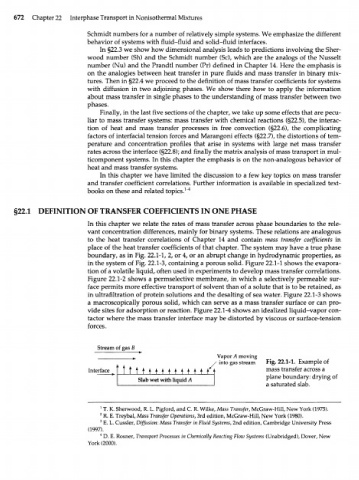
                           boundary, as  in Fig. 22.1-1, 2, or 4, or an abrupt  change  in hydrodynamic  properties, as
                           in the system  of  Fig. 22.1-3, containing a porous  solid.  Figure  22.1-1  shows  the evapora-
                           tion  of  a volatile  liquid, often  used  in experiments  to develop  mass  transfer  correlations.
                           Figure  22.1-2  shows  a  permselective  membrane, in which  a  selectively  permeable  sur-
                           face permits more effective  transport  of  solvent  than  of  a solute  that is  to be retained, as
                           in ultrafiltration  of protein solutions  and the desalting  of  sea  water.  Figure 22.1-3  shows
                           a  macroscopically  porous  solid,  which  can serve  as  a  mass  transfer  surface  or  can pro-
                           vide  sites  for adsorption or reaction. Figure 22.1-4 shows  an idealized  liquid-vapor  con-
                           tactor where  the mass  transfer  interface  may  be distorted  by  viscous  or  surface-tension
                           forces.


                              Stream  of  gas  В
                                                                 Vapor A  moving
                                                                /  into gas stream  Fig.  22.1-1.  Example of
                           Interface     j l l l l l l l l l l ^ l             mass transfer  across a
                                                                               mass transrer across a
                                          Slab wet with liquid A  I            P  l a n e  boundary: drying  of
                                                                1              a saturated  slab.

                                T.  K. Sherwood,  R.  L. Pigford, and  С  R. Wilke, Mass Transfer, McGraw-Hill,  New  York (1975).
                               1
                               2
                                R. E. Treybal, Mass Transfer Operations, 3rd  edition,  McGraw-Hill,  New  York (1980).
                               3
                                E. L. Cussler, Diffusion: Mass Transfer in Fluid Systems, 2nd  edition,  Cambridge University Press
                           (1997).
                                D. E. Rosner, Transport Processes in Chemically Reacting Flow Systems (Unabridged), Dover,  New
                               4
                           York  (2000).

