


Page 694 - Bird R.B. Transport phenomena
P. 694
674  Chapter  22  Interphase Transport in Nonisothermal Mixtures

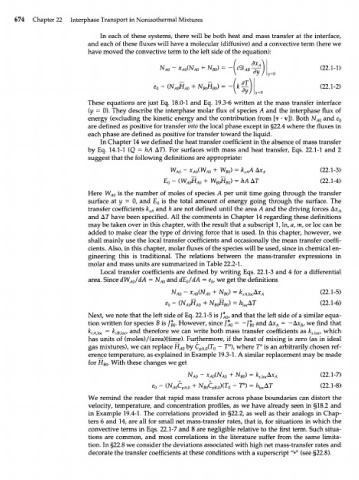
                               In  each of  these systems, there will be both  heat and mass  transfer  at the interface,
                           and  each of these fluxes  will have a molecular (diffusive)  and a convective term  (here we
                           have moved the convective term to the left side of the equation):

                                                    "  x (N A0  + N )  = -[  c® AB  ^          (22.1-1)
                                                      A0
                                                                B0
                                                                                               (22.1-2)

                           These equations are just  Eq. 18.0-1 and Eq. 19.3-6 written at the mass  transfer interface
                           (y  = 0). They describe the interphase molar flux  of  species A  and the interphase flux of
                           energy  (excluding the kinetic energy and the contribution  from  [т • v]). Both N AQ  and e 0
                           are  defined as positive for transfer into the local phase except in §22.4 where the fluxes in
                           each phase are defined as positive for transfer toward the liquid.
                               In Chapter  14 we defined the heat transfer coefficient  in the absence of mass transfer
                           by  Eq. 14.1-1  (Q  = hA  AT). For surfaces  with  mass and heat  transfer, Eqs. 22.1-1 and 2
                           suggest  that the following  definitions are appropriate:

                                                   ™ло  "  x (W  + W ) = k A  Ax               (22.1-3)
                                                          A0  A0    B0   xA   A
                                                 E  -  (Wjl  + W H ) = hA AT                   (22.1-4)
                                                  o      A0      B0  B0
                           Here  W A0  is  the number of  moles  of  species A  per unit  time going  through the transfer
                           surface  at у  =  0, and  £ 0  is  the  total  amount  of  energy  going  through  the  surface.  The
                           transfer  coefficients  k xA and  h are not defined  until the area A and  the driving  forces  Ax A
                           and  AT have been  specified.  All the comments  in Chapter  14 regarding  these  definitions
                           may be taken over in this chapter, with the result that a subscript  1, In, a, m, or loc can be
                           added  to make  clear  the type  of driving  force  that  is used.  In this chapter, however,  we
                           shall mainly use the local transfer  coefficients  and  occasionally  the mean  transfer  coeffi-
                           cients. Also, in this chapter, molar fluxes  of the species will be used, since in chemical en-
                           gineering  this  is  traditional.  The  relations  between  the  mass-transfer  expressions  in
                           molar and mass units are summarized  in Table 22.2-1.
                               Local transfer  coefficients  are defined  by writing  Eqs. 22.1-3 and  4 for  a  differential
                           area. Since dW AQ/dA  = N A0 and dE 0/dA  = e 0, we get the  definitions

                                                    N A0  ~  x A0(N A0  +  N B0)  = k xA>]ocAx A  (22.1-5)
                                                  e
                                                  o  ~  (N AOH A0  +  N BOH B0)  = h locAT     (22.1-6)
                           Next, we note that the left  side  of Eq. 22.1-5 is /* 0, and  that the left side of a similar equa-
                           tion written  for species  В is / . However, since ]*  =  — /  and Ax A  =  — Ax , we  find  that
                                                   B0
                                                                                          B
                                                                    AQ
                                                                           B0
                           KA,\OC  =  Кв,\оо  а п с  *  therefore we  can write both  mass  transfer  coefficients  as k xXoc ,  which
                           has  units of  (moles) /(area)(time).  Furthermore,  if  the heat  of  mixing is zero (as in ideal
                           gas mixtures), we can replace H A0  by C (T 0  — T°), where T° is an arbitrarily chosen  ref-
                                                            pA0
                           erence temperature, as explained in Example 19.3-1. A similar replacement may be made
                           for  H . With these changes we get
                                B0
                                                        N^o  "  x (N  + N )  = k ^x            (22.1-7)
                                                               A0  A0   B0   x  A
                                              e  '  (N C  +  N C,  )(T  -  Г)  = h AT          (22.1-8)
                                               0    A0  pAt0  B 0  B / 0  0  ]oc
                           We  remind the reader that  rapid mass  transfer across phase boundaries can distort the
                           velocity, temperature, and concentration  profiles, as we  have already seen in §18.2 and
                           in  Example 19.4-1. The correlations provided in §22.2, as well  as  their  analogs in Chap-
                           ters 6 and  14, are all  for  small net mass-transfer rates, that  is, for situations in which the
                           convective terms in Eqs. 22.1-7 and 8 are negligible relative to the first term. Such situa-
                           tions  are common, and  most correlations in  the literature suffer  from  the same limita-
                           tion. In §22.8 we consider the deviations associated with high net mass-transfer rates and
                           decorate the transfer coefficients  at these conditions with a superscript "•" (see §22.8).

