


Page 697 - Bird R.B. Transport phenomena
P. 697
§22.2  Analytical Expressions for Mass Transfer Coefficients  677
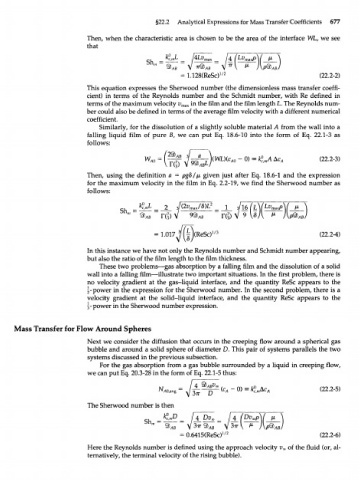
                           Then, when  the characteristic area  is  chosen to be the area  of  the interface  WL, we  see
                           that
                                                                                   \
                                                                              KP^ABJ )
                                                      =  1.128(ReSc) 1/2                       (22.2-2)

                           This  equation expresses  the Sherwood number (the dimensionless mass  transfer  coeffi-
                           cient)  in  terms  of  the Reynolds number and  the Schmidt number, with  Re defined  in
                           terms  of the maximum velocity v max  in the film and the film length L. The Reynolds num-
                           ber  could also be defined in terms of the average film velocity with a different numerical
                           coefficient.
                              Similarly, for  the dissolution of  a slightly  soluble material A  from  the wall  into a
                           falling  liquid  film  of  pure  B, we  can put  Eq.  18.6-10  into  the  form  of  Eq.  22.1-3  as
                           follows:

                                                                       -  0) s  k° A  Ac A     (22.2-3)
                                                                              c>m
                                                    ©
                           Then,  using  the definition а  =  pgS/fx  given  just  after  Eq.  18.6-1  and  the expression
                           for  the maximum velocity  in the film  in  Eq. 2.2-19, we  find  the Sherwood number as
                           follows:

                                                              2
                                          C L   ^ _  J(2v JS)L _   i   J16  (L\(LV«»P\(  H  \
                                        =     =          ma
                                       '"  ®     ©  V    9а       г© V  9  \s)\  м  Дра   J
                                            AB  r          лв
                                               =  1.017  7  £  (ReSc) 1/3                      (22.2-4)


                           In this instance we have not only the Reynolds number and Schmidt number  appearing,
                           but also the ratio of the film length to the film  thickness.
                              These two problems—gas  absorption  by a falling  film  and  the dissolution  of a solid
                           wall into a falling  film—illustrate  two important  situations. In the first  problem, there is
                           no  velocity  gradient  at  the  gas-liquid  interface,  and  the  quantity  ReSc  appears  to  the
                           \-power  in  the expression  for  the Sherwood  number.  In  the  second  problem,  there  is a
                           velocity  gradient  at  the  solid-liquid  interface,  and  the  quantity  ReSc  appears  to  the
                           I -power in the Sherwood number  expression.


     Mass Transfer for Flow Around Spheres
                           Next  we consider  the  diffusion  that  occurs  in  the creeping  flow  around  a spherical  gas
                           bubble and  around  a solid  sphere  of diameter  D. This pair  of systems  parallels the  two
                           systems discussed  in the previous  subsection.
                               For the gas absorption  from  a gas bubble surrounded  by  a liquid  in creeping  flow,
                           we can put  Eq. 20.3-28 in the form  of Eq. 22.1-5 thus:

                                                                     -  0) s  jtf  дс          (22.2-5)
                                                                   A
                                                           г  D
                           The  Sherwood number is then


                                                      =  0.6415(ReSc) 1/2                      (22.2-6)
                           Here the Reynolds number is defined using the approach velocity v x  of the fluid  (or, al-
                           ternatively, the terminal velocity  of the rising bubble).

