


Page 699 - Bird R.B. Transport phenomena
P. 699
§22.3  Correlation of  Binary Transfer  Coefficients  in One Phase  679

     Mass Transfer in  the  Neighborhood  of  a Rotating Disk
                           For a disk  of  diameter  D coated  with  a slightly  soluble  material A  rotating with  angular
                           velocity  П in  a  large  region  of  liquid  B, the mass  flux  at  the surface  of  the disk  is  inde-
                           pendent  of position. According  to Eq. 19D.4-7 we  have

                                               N A0  = 0.6201  „i/6  (c A0  -  0)  -          (22.2-13)

                           This may be expressed  in terms  of the Sherwood  number as

                                                        /Ш  1 / 2 р  1 / 6  \
                                       Sh  =      =  0.620         =  0.620
                                          m                 1/3  1/6
                                                        \ 2)  д  /
                                                  =  0.620 Re Sc 1/3                          (22.2-14)
                                                           1/2
                           Here the characteristic velocity  in the Reynolds number is chosen to be  Dft.

     §22.3   CORRELATION      OF BINARY    TRANSFER
             COEFFICIENTS    IN  ONE  PHASE
                           In  this  section  we  show  that  correlations  for  binary  mass  transfer  coefficients  at  low
                           mass-transfer  rates  can be obtained directly  from  their heat transfer  analogs  simply  by  a
                           change  of  notation. These correspondences are quite useful,  and many heat transfer  cor-
                           relations have, in fact, been obtained  from  their mass  transfer  analogs.
                              To  illustrate  the  background  of  these  useful  analogies  and  the  conditions  under
                           which  they  apply,  we  begin  by  presenting  the  diffusional  analog  of  the  dimensional
                           analysis  given  in  §14.3.  Consider  the  steadily  driven,  laminar  or  turbulent  isothermal
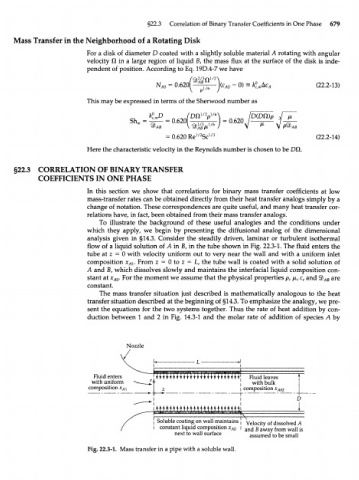
                           flow  of  a liquid  solution  of  A  in  B, in the tube shown  in  Fig. 22.3-1. The fluid  enters the
                           tube  at  z  =  0 with  velocity  uniform  out  to very  near  the wall  and  with  a  uniform  inlet
                           composition  x AV  From  z  =  0  to z  =  L, the tube wall  is  coated  with  a  solid  solution  of
                           A  and  B, which  dissolves slowly  and maintains the interfacial  liquid  composition con-
                           stant at x .  For the moment we  assume  that the physical  properties p, jx, c, and %b  are
                                  AQ
                                                                                                 AB
                           constant.
                              The  mass  transfer  situation  just  described  is  mathematically  analogous  to  the heat
                           transfer  situation described  at the beginning  of  §14.3. To emphasize the analogy, we pre-
                           sent  the equations  for  the two  systems  together. Thus  the rate  of  heat addition by  con-
                           duction  between  1 and  2  in  Fig.  14.3-1  and  the molar  rate  of  addition  of  species  A  by


                                      Nozzle


                             Fluid  enters
                            with uniform
                           composition  x A]


                                              I Soluble  coating  on wall maintains  (  Velocity of dissolved  A
                                              I  constant  liquid composition x A0  \  and  В away from wall is
                                                    next  to wall  surface  assumed  to be small

                           Fig. 22.3-1.  Mass transfer  in a pipe with a soluble wall.

