


Page 704 - Bird R.B. Transport phenomena
P. 704
684  Chapter 22  Interphase Transport in Nonisothermal Mixtures


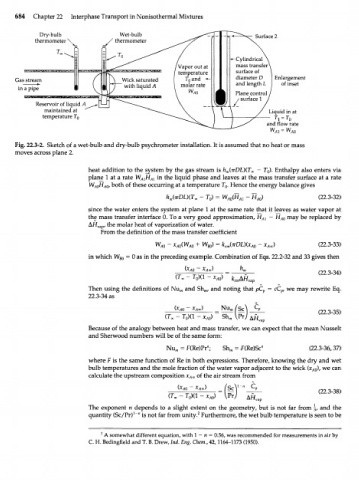
             Dry-bulb               Wet-bulb                                Surface 2
            thermometer            thermometer

                                                                     -*- Cylindrical
                                                      Vapor  out at   mass  transfer
                                                      temperature     surface of
      Gas  stream                    Wick saturated     T  and  •*-   diameter D  Enlargement
                                                         o
           • — •                      with liquid A   molar rate      and  length L  of inset
       in a pipe                                         W            Plane control
                                                                        surface 1
            Reservoir  of liquid A
              maintained at                                                     Liquid in at
              temperature T                                                       h
                        o                                                             0
                                                                                and  flow rate

      Fig. 22.3-2.  Sketch  of a wet-bulb  and dry-bulb  psychrometer installation. It is assumed  that no heat or mass
      moves  across plane 2.

                           heat addition to the system  by  the gas  stream  is  h (7rDL)(T K  -  T ). Enthalpy also  enters  via
                                                                                 o
                                                                    m
                           plane 1 at a rate  W H Al  in the liquid  phase  and  leaves  at the mass  transfer  surface  at a rate
                                           M
                           W H , both  of these occurring at a temperature T . Hence the energy  balance gives
                             AO
                                A0
                                                                    o
                                                            -  To) =     -  H )                (22.3-32)
                                                                             A0
                           since  the water  enters the system  at plane  1 at the same rate that it leaves as  water  vapor  at
                           the  mass  transfer  interface  0. To a very  good  approximation, H A]  -  H AQ  may  be replaced  by
                           AH , the molar heat of vaporization  of  water.
                              vap
                               From the definition  of the mass transfer  coefficient
                                                 O         + W ) = k (7rDD(x A0  -  x J        (22.3-33)
                                                                   xm
                                                              B0
                                                                                A
                           in  which  W B0  = 0 as in the preceding example. Combination of  Eqs. 22.2-32 and 33 gives then
                                                                                               (22.3-34)
                                                        -  T )(l  -
                                                           0
                           Then  using  the definitions  of  Nu w  and  Sh , and  noting  that pC p  = cC , we  may  rewrite  Eq.
                                                                                    p
                                                             m
                           22.3-34 as
                                                                                               (22.3-35)
                                                  (T.  -  T )(l  -  x )  Sh  \?r
                                                        0     A0     m      -*vap
                           Because  of  the analogy  between  heat and mass  transfer, we  can expect that the mean Nusselt
                           and  Sherwood  numbers will be  of the same  form:
                                                  Nu  = HRe)Pr";   Sh  =  F(Re)Sc"          (22.3-36,37)
                                                     M               m
                           where  F is  the same  function  of  Re in both expressions.  Therefore, knowing  the dry  and  wet
                           bulb temperatures and the mole fraction  of the water vapor  adjacent  to the wick (х ), we can
                                                                                             ло
                           calculate the upstream composition x Aoo  of the air stream  from
                                                           х )      Sc                         (22.3-38)
                                                           Аж
                                                   (Т.  -  То)<1 -  x )   AH, vap
                                                               A0
                           The  exponent  n depends  to a  slight  extent  on  the  geometry,  but  is  not  far  from  |,  and  the
                                         1
                                                           2
                           quantity (Sc/Pr) "" is not far  from unity.  Furthermore, the wet bulb temperature is seen to be
                               2  A somewhat different  equation, with 1 -  n = 0.56, was recommended for measurements in air by
                           С. Н. Bedingfield  and Т. В. Drew, Ind. Eng. Chem., 42,1164-1173 (1950).

