


Page 705 - Bird R.B. Transport phenomena
P. 705
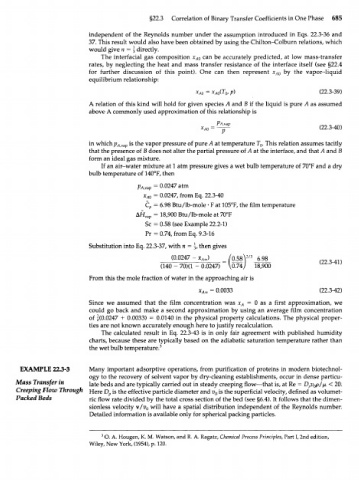
§22.3  Correlation of  Binary Transfer  Coefficients  in One Phase  685

                           independent  of  the Reynolds  number under  the assumption  introduced  in  Eqs.  22.3-36  and
                           37. This result  would  also  have been obtained  by using  the Chilton-Colburn relations, which
                           would  give n = \ directly.
                               The  interfacial  gas  composition  x A0  can be  accurately  predicted, at  low  mass-transfer
                           rates, by  neglecting  the  heat  and  mass  transfer  resistance  of  the interface  itself  (see  §22.4
                           for  further  discussion  of  this  point).  One  can  then  represent  x A0  by  the  vapor-liquid
                           equilibrium  relationship:
                                                              =  x (T 0/  p)                   (22.3-39)
                                                                A0
                           A relation  of  this kind  will hold  for  given  species  A  and В if  the liquid  is pure A  as  assumed
                           above A commonly used  approximation  of this relationship is
                                                                 PA,,,
                                                            X                                  (22.3-40)
                                                             A0  -  '
                           in  which p A>vap  is the vapor  pressure  of pure A  at temperature T . This relation assumes  tacitly
                                                                              Q
                           that the presence  of В does not alter the partial pressure  of A  at the interface, and that A  and В
                           form  an ideal gas  mixture.
                               If an air-water  mixture at 1 atm pressure gives a wet  bulb  temperature of  70°F and a dry
                           bulb temperature of  140°F, then

                                          p Ayap  = 0.0247 atm
                                           x A0  = 0.0247, from  Eq. 22.3-40
                                            C  = 6.98 Btu/lb-mole • F at 105°F, the film temperature
                                             p
                                         AH   = 18,900 Btu/lb-mole at 70°F
                                            vap
                                            Sc  = 0.58  (see Example  22.2-1)
                                            Pr  = 0.74, from  Eq. 9.3-16
                           Substitution into Eq. 22.3-37, with  n = \, then gives

                                                    (0.0247  -  x J  /058Y /3  6.98
                                                            A     =                            (22.3-41)
                                                (140 -  70)(l  -  0.0247)  \0.74/  18,900
                           From this the mole fraction  of water in the approaching air is

                                                            x  = 0.0033                        (22.3-42)
                                                            Ax
                           Since  we  assumed  that  the  film  concentration was  x A  =  0  as  a  first  approximation,  we
                           could  go  back  and  make  a  second  approximation  by  using  an  average  film  concentration
                           of  ^(0.0247  4- 0.0033)  =  0.0140 in  the physical  property  calculations.  The physical  proper-
                           ties are not known  accurately enough here to justify  recalculation.
                               The  calculated  result  in  Eq.  22.3-43  is  in  only  fair  agreement  with  published  humidity
                           charts, because  these are typically  based  on the adiabatic  saturation temperature rather than
                           the  wet bulb temperature. 3


       EXAMPLE   22.3-3    Many  important adsorptive  operations, from  purification  of  proteins  in  modern biotechnol-
                           ogy  to the recovery  of  solvent  vapor  by  dry-cleaning  establishments,  occur in dense particu-
      Mass  Transfer in    late beds and are typically  carried out in steady  creeping flow—that  is, at Re = D v p/ix < 20.
      Creeping Flow Through  Here D  is the effective  particle diameter and v  is the superficial  velocity, defined  p o  volumet-
                                                                                            as
      Packed  Beds         ric flow p  rate divided  by  the total cross  section  0 of the bed  (see §6.4). It follows  that the dimen-
                           sionless  velocity  v/v 0  will  have  a  spatial  distribution  independent  of  the Reynolds  number.
                           Detailed information is available  only  for  spherical packing  particles.


                               3
                                O. A. Hougen, K. M. Watson, and  R. A. Ragatz, Chemical Process Principles,  Part I, 2nd edition,
                           Wiley, New York, (1954), p. 120.

