


Page 706 - Bird R.B. Transport phenomena
P. 706
686   Chapter 22  Interphase Transport in Nonisothermal Mixtures

                              Using  the dimensional  analysis  discussion  at  the beginning  of  this  section, predict  the
                           form  of  the steady-state  mass  transfer  coefficient  correlation for  creeping  flow.
     SOLUTION              The dimensional analysis  procedure in §19.5 may be used, with D  as the characteristic length
                                                                               p
                           and  v  the characteristic  velocity.  Then, from  Eq. 19.5-11, we  see  that the dimensionless  con-
                               Q
                           centration depends only  on the product ReSc, in addition to the dimensionless  position coor-
                           dinates and the geometry  of the bed.
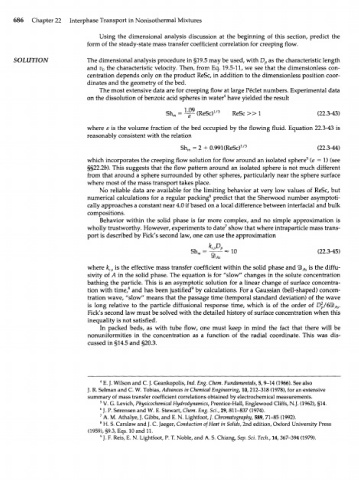
                              The most extensive  data are for  creeping flow  at large Peclet numbers. Experimental data
                           on the dissolution  of benzoic acid spheres in water 4  have yielded  the result

                                                  Sh  = ^  (ReSc) 1 / 3  ReSc > >  1          (22.3-43)
                                                    w
                           where  E is  the volume  fraction  of  the bed  occupied  by  the flowing  fluid.  Equation 22.3-43  is
                           reasonably  consistent with  the relation

                                                      Sh w  = 2 + 0.991 (ReSc) 1 / 3          (22.3-44)
                                                                                           5
                           which incorporates the creeping  flow solution for  flow around an isolated  sphere  {e = 1) (see
                           §§22.2b). This suggests that the flow  pattern around  an isolated  sphere  is  not much  different
                           from  that around a sphere surrounded  by  other spheres, particularly  near the sphere  surface
                           where most  of the mass transport takes place.
                              No  reliable  data  are  available  for  the limiting  behavior  at very  low  values  of  ReSc, but
                           numerical  calculations  for  a regular  packing 6  predict  that the Sherwood  number  asymptoti-
                           cally  approaches a constant near 4.0  if based  on a local difference  between  interfacial  and bulk
                           compositions.
                               Behavior  within  the  solid  phase  is  far  more  complex,  and  no  simple  approximation  is
                                                                   7
                           wholly  trustworthy. However, experiments to date  show  that where intraparticle mass trans-
                           port is described  by  Fick's second law, one can use the approximation

                                                         Sh m  =  - ^  *  10                  (22.3-45)
                           where  k cs  is the effective  mass  transfer  coefficient  within  the solid  phase and ЯЬ  is the  diffu-
                                                                                           As
                           sivity  of A  in the solid  phase. The equation is  for  "slow"  changes  in the solute concentration
                           bathing  the particle. This  is  an asymptotic  solution  for  a linear  change  of  surface  concentra-
                                       8
                           tion with  time,  and has been justified 9  by  calculations.  For a Gaussian  (bell-shaped) concen-
                           tration wave, "slow" means that the passage time (temporal standard  deviation)  of the wave
                                                                                               2
                           is  long  relative  to  the particle  diffusional  response  time, which  is  of  the order  of D /64b .
                                                                                               p
                                                                                                    As
                           Fick's second law  must be solved with the detailed  history  of surface  concentration when this
                           inequality  is not satisfied.
                               In  packed  beds,  as  with  tube  flow,  one  must  keep  in  mind  the  fact  that  there will  be
                           nonuniformities  in  the  concentration as  a  function  of  the  radial  coordinate. This  was  dis-
                           cussed  in §14.5 and §20.3.


                               4
                                E. J. Wilson  and С  J. Geankopolis, Ind. Eng.  Chem. Fundamentals,  5, 9-14  (1966). See also
                           J. R. Selman and C. W. Tobias, Advances  in Chemical Engineering, 10, 212-318 (1978), for an  extensive
                           summary  of mass transfer  coefficient  correlations obtained by  electrochemical measurements.
                               5
                                V.  G. Levich, Physicochemical Hydrodynamics,  Prentice-Hall, Englewood  Cliffs,  NJ. (1962), §14.
                               6
                                J. P. Stfrensen and W.  E. Stewart, Chem. Eng.  Sci., 29, 811-837 (1974).
                                A. M. Athalye, J. Gibbs, and  E. N. Lightfoot, J. Chromatography, 589, 71-85  (1992).
                               7
                                H. S. Carslaw  and ]. С  Jaeger, Conduction of Heat in Solids, 2nd edition, Oxford  University  Press
                               8
                           (1959), §9.3, Eqs. 10 and 11.
                               9
                                J. F. Reis, E. N. Lightfoot,  P. T. Noble, and A.  S. Chiang, Sep. Sci. Tech., 14, 367-394  (1979).

