


Page 707 - Bird R.B. Transport phenomena
P. 707
§22.4  Definition  of Transfer  Coefficients  in Two Phases  687

       EXAMPLE 22.3-4      In both gas-liquid 10  and liquid-liquid 11  contactors, sprays  of liquid drops or clouds  of  bubbles
                           are frequently  encountered. Contrast their mass transfer behavior with that of solid  spheres.
      Mass  Transfer  to  Drops
      and  Bubbles
                           SOLUTION
                           Many  different  types  of behavior  are encountered, and surface  forces  can play  a very impor-
                           tant role. We discuss  surface  forces  in some detail in §22.7. Here we consider only some limit-
                           ing cases and refer  readers to the above-cited  references.
                               Very  small drops and bubbles  behave  like  solid  spheres and can be treated by  the corre-
                           lations in Example 22.3-3 and in Chapter 14. However,  if both adjacent phases are free  of  sur-
                           factants  and  small  particulate  contaminants, the  interior  phase  circulates  and  carries  the
                           adjacent regions  of the exterior phase along. This stress-driven  "Hadamard-Rybczinski circu-
                           lation //12  increases  the mass  transfer  rates markedly, often  by  almost  an order  of magnitude,
                           and  the rates  can be estimated  from  extensions  1316  of  the "penetration model" discussed  in
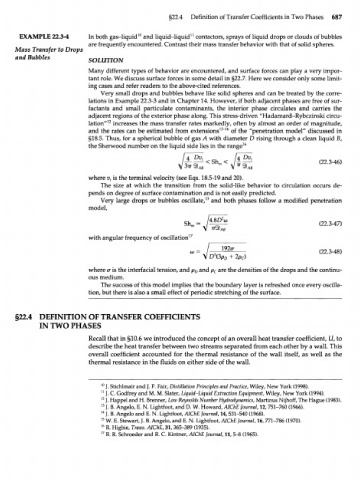
                           §18.5. Thus, for  a spherical bubble  of  gas  A  with  diameter D rising  through a clean liquid  B,
                           the Sherwood number on the liquid  side lies in the range 16

                                                                                               (22.3-46)

                           where v t  is the terminal velocity  (see Eqs. 18.5-19 and 20).
                               The  size  at  which  the  transition  from  the  solid-like  behavior  to  circulation  occurs de-
                           pends on degree  of surface  contamination and is not easily predicted.
                               Very  large  drops  or  bubbles  oscillate, 13  and  both phases  follow  a  modified  penetration
                           model,
                                                       Sh.                                     (22.3-47)

                           with angular frequency  of oscillation 1
                                                                  192<7
                                                                                               (22.3-48)
                                                                3
                                                               D (3p D  + 2p c )
                           where a is the interfacial  tension, and p D  and p  are the densities  of the drops and the continu-
                                                                c
                           ous medium.
                               The success  of this model implies that the boundary layer is refreshed  once every  oscilla-
                           tion, but there is also a small effect  of periodic stretching of the surface.


      §22.4  DEFINITION    OF TRANSFER      COEFFICIENTS
             IN  TWO  PHASES

                           Recall that in §10.6 we introduced the concept of an overall heat transfer  coefficient,  U, to
                           describe the heat transfer between two streams separated from  each other by  a wall. This
                           overall  coefficient  accounted  for  the thermal resistance  of  the wall  itself, as  well  as  the
                           thermal resistance in the fluids  on either side  of the wall.


                               10
                                 J. Stichlmair and J. F. Fair, Distillation  Principles and Practice, Wiley, New York (1998).
                               11
                                 J. С  Godfrey and M. M. Slater, Liquid-Liquid Extraction Equipment, Wiley, New York (1994).
                                 J. Happel and H. Brenner, Low Reynolds Number Hydrodynamics, Martinus Nijhoff, The Hague (1983).
                               12
                                 J. B. Angelo, E. N. Lightfoot, and D. W. Howard, AIChE Journal, 12, 751-760 (1966).
                               13
                               14
                                 J. B. Angelo and E. N. Lightfoot, AIChE Journal, 14, 531-540 (1968).
                                 W.  E. Stewart, J. B. Angelo, and E. N. Lightfoot, AIChE Journal, 16, 771-786 (1970).
                               15
                                R. Higbie, Trans. AIChE, 31, 365-389 (1935).
                               16
                               17
                                R. R. Schroeder and R. C. Kintner, AIChE Journal, 11,5-8 (1965).

