


Page 710 - Bird R.B. Transport phenomena
P. 710
690  Chapter 22  Interphase Transport in Nonisothermal Mixtures

                               The  mean two phase mass transfer  coefficients  must be defined  carefully,  and we con-
                            sider  here only  the special  case where  bulk  concentrations in  the two  adjacent  phases  do
                            not  change significantly  over the total mass-transfer  surface  S. We may then define K°  by
                                                                                                  XIU
                                                     |
                                             (N )  = J  K° , (x  -  x )dS  = K'JXAC  ~         (22.4-11)
                                               A0 m       x loc  Ae  Ab
                            so that, when  Eq. 22.3-9 is  used,

                                                                             -dS               (22.4-12)
                            Frequently  area  mean  overall  mass  transfer  coefficients  are  calculated  from  area  mean
                            coefficients  for the two adjoining  phases:

                                                                                               (22.4-13)
                                                     х
                                                     дг,арргох  (I/O  +  а/т Щ,„)
                                                                          х
                            The  two  mean values  in  Eqs. 22.4-12  and  13 can be  significantly  different  (see  Example
                            22.4-3).

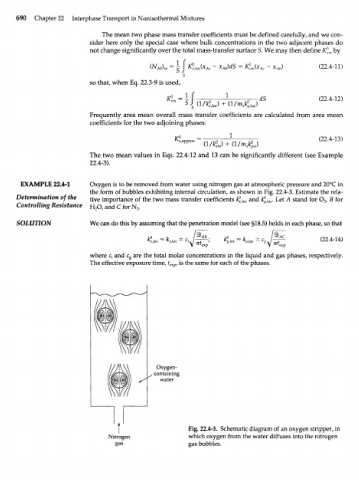
       EXAMPLE 22.4-1       Oxygen  is to be removed  from  water using  nitrogen gas  at atmospheric pressure and 20°C in
                            the  form  of bubbles  exhibiting  internal circulation, as shown  in Fig. 22.4-3. Estimate the rela-
      Determination  of  the  t i v e  importance of  the two  mass  transfer  coefficients  k°  and  ^  l o c .  Let Л stand  for  О„ В for
                                                                        xloc
      Controlling Resistance  H O, and С for N .
                                         2
                             2
      SOLUTION              We can do this by assuming that the penetration model (see §18.5) holds in each phase, so that
                                             t°  «  k  = r,  /  —•  к 0  «  к  —г  /  л с      СУ)  4-1 А.)

                            where  с, and  c  are the total molar concentrations in the liquid  and  gas  phases,  respectively.
                                       g
                            The  effective  exposure time, f , is the same for  each of the phases.
                                                   exp


                                               Oxygen-
                                              , containing
                                                water


                                                         Fig.  22.4-3.  Schematic diagram  of an oxygen  stripper, in
                                 Nitrogen                which oxygen  from the water diffuses  into the nitrogen
                                   gas                   gas  bubbles.

