


Page 712 - Bird R.B. Transport phenomena
P. 712
692   Chapter 22  Interphase Transport in Nonisothermal Mixtures

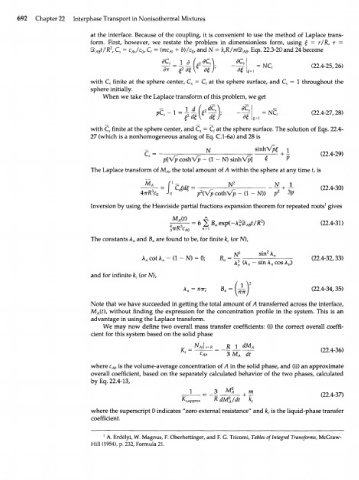
                            at  the interface.  Because  of  the coupling,  it  is  convenient to use  the method  of  Laplace trans-
                            form.  First,  however,  we  restate  the  problem  in  dimensionless  form,  using  f  =  r/R,  т =
                            9) t/R 2 f  C  = c /c ,  C, = (mc , + b)/c ,  and N = k R/m9) .  Eqs. 22.3-20 and 24 become
                                                         0
                                    5
                             AB
                                                                   c
                                                                        AB
                                        As
                                          0
                                                   A
                                                             асЛ      ac
                                                 ~ ~s  i  и  I  У2  5  I  s s  = NQ          (22.4-25,26)
                            with  C s  finite  at  the sphere  center, C s  =  C, at  the sphere  surface,  and  C s  = 1 throughout the
                            sphere  initially.
                               When  we take the Laplace transform  of this problem, we  get
                                                              *С
                                                                              = NQ           (22.4-27,28)
                            with Q  finite  at the sphere center, and C  = Q at the sphere surface.  The solution  of  Eqs. 22.4-
                                                            s
                            27 (which is a nonhomogeneous analog  of  Eq. C.I-6a) and 28 is
                                            —                 N             sinh \v£  i
                                             s  =   7=     F             7=    1-  +  ^        (22.4-29)
                                                 p[Vp  coshVp  -  (1 -  N) sinhV^]  f  ^
                            The Laplace  transform  of M A,  the total amount  of A within  the sphere  at any  time  t, is

                                                                                               (22.4-30)
                                              3
                                                            2
                                           4тгЯ с  h  s    p (Vp  cothVp  -  (1 -  N))  p 2  3 P
                                               0
                                                                                                 1
                            Inversion by using the Heaviside  partial fractions  expansion theorem for repeated roots  gives
                                                                             2
                                                       *  • = 6 2  B  exp(-Al® t/R )             (22.4-31)
                                                                         AB
                                                                  n
                            The  constants  A,, and B  are found  to be, for finite  k  (or N),
                                                                    c
                                              n
                                           А  cot A,, -  (1 -  N) = 0;  B  = Щ  ^ - ^  —     (22.4-32,33)
                                            и                      n
                                                                      A?,  (A,, -sinA cosA, )
                                                                                n     z
                            and  for infinite  k  (or N),
                                         c
                                                                      (  1  V
                                                                                             (22.4-34,35)
                            Note that we  have succeeded  in getting the total amount of A  transferred  across the interface,
                            M (t),  without  finding  the expression  for  the concentration profile  in  the system.  This  is  an
                              A
                            advantage  in using  the Laplace transform.
                                We  may  now  define  two  overall  mass  transfer  coefficients:  (i) the correct overall  coeffi-
                            cient for  this system  based  on the solid  phase
                                                          Щ^      _к  i  dM*                      .
                                                      к         =                              ( 2 2 4 3 6 )
                                                            С АЬ    3 M  dt
                                                                       A
                            where c Ab  is the volume-average  concentration of A  in the solid phase, and (ii) an approximate
                            overall  coefficient,  based  on the separately  calculated  behavior  of  the two  phases, calculated
                            by  Eq. 22.4-13,
                                                             -      °   + ^                    (22.4-37)
                                                         1      3  M
                                                                R  dM° /dt  К
                                                                     A
                            where the superscript  0 indicates  "zero external resistance" and k  is the liquid-phase  transfer
                                                                                c
                            coefficient.
                                1
                                 A. Erdelyi, W. Magnus, F. Oberhettinger, and F. G. Tricomi, Tables of Integral Transforms, McGraw-
                            Hill (1954), p. 232,  Formula 21.

