


Page 700 - Bird R.B. Transport phenomena
P. 700
680  Chapter 22  Interphase Transport in Nonisothermal Mixtures
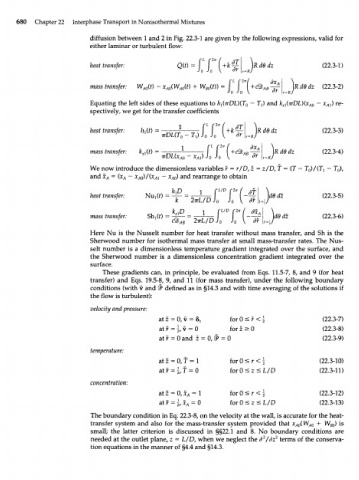
                            diffusion  between  1 and 2 in Fig. 22.3-1 are given by  the following  expressions,  valid  for
                            either laminar or turbulent  flow:

                                                            f L  f 27T  I
                            heat transfer:           Q(t)  =  I  |  +k     XRdQdz               (22.3-1)
                                                           J о  J о
                            mass  transfer:  W (t)  -  x (W (t)  + W (t))  =  Г  f  [ +сЯЬ  ^  к  rf0 rfz  (22.3-2)
                                                  A0
                                           A0
                                                     A0
                                                              B0
                                                                               АВ
                                                                    J  Jo  \     dY  r=R/
                                                                     0
                            Equating the left  sides  of  these equations to /I (7TDL)(T  -  TJ  and k (irDL)(x  -  x )  re-
                                                                  1      0          xl      A0   M
                            spectively,  we  get  for  the transfer  coefficients
                            heattransfer.  Ц 0  -                           ]R  dO dz           (22.3-3)
                                                                          =R/
                            mass transfer:  k At) =                      AB  ЭХА  )R dd dz      (22.3-4)
                                           x
                                                                Jo
                                                 TTDL(X A0  -  x Al ) J J o o  Jo  dr
                            We  now introduce the dimensionless variables  f  = r/D,  z  = z/D,  T = (T -  T )/(T^ -  T ),
                                                                                            0
                                                                                                    o
                            and  x  = (x  -  x )/(x  -  x )  and rearrange to obtain
                                A    A    A0  M    A0
                                                                   U
                            heat transfer:   Nu,(t) = ^-  = —f—  f °  Г" - §    U  dz           (22.3-5)
                                                                        (
                                                     к   2TTL/D  J O  Jo  \  dr
                                                                       2тг
                                                    к ,D     1   f L/D  Г  /  дхл  \
                            mass transfer:   S\\ (f) = -g—  = ^  i           ^                  (22.3-6)
                                    ;
                                               x
                                                             / n t
                                                    c4t AB  lirL/DJo  J  o  V  ^  r =J
                            Here  Nu  is  the Nusselt  number  for  heat  transfer  without  mass  transfer,  and  Sh  is  the
                            Sherwood  number  for  isothermal mass  transfer  at  small  mass-transfer  rates. The Nus-
                            selt  number  is  a  dimensionless  temperature gradient  integrated  over  the surface,  and
                            the  Sherwood  number  is  a  dimensionless  concentration gradient  integrated  over  the
                            surface.
                               These  gradients  can, in  principle, be  evaluated  from  Eqs.  11.5-7,  8, and  9  (for  heat
                            transfer)  and  Eqs.  19.5-8,  9, and  11  (for  mass  transfer), under  the  following  boundary
                            conditions  (with  v  and & defined  as  in §14.3 and with  time averaging  of  the solutions  if
                            the  flow  is turbulent):
                            velocity  and pressure:
                                                at  z  = 0, v  =     for  0 <  r < \            (22.3-7)
                                                                     for z >  0                 (22.3-8)
                                                at  f  = 0 and z = 0,Ф =  0                     (22.3-9)
                            temperature:
                                                at z = 0, f  = 1     for  0 <  r < ^           (22.3-10)
                                                at f  = \, f  = 0    forO  < z <  L/D          (22.3-11)

                            concentration:
                                                atz  = 0,x  == 1     for  0 <  r < \           (22.3-12)
                                                        A
                                                atr  = ix  ==  0     for  0 <  z <  L/D        (22.3-13)
                                                       A
                            The  boundary condition in Eq. 22.3-8, on the velocity  at the wall, is accurate for  the heat-
                            transfer  system  and  also  for  the mass-transfer  system  provided  that x (W  +  W )  is
                                                                                        A0  A0    B0
                            small;  the  latter  criterion  is  discussed  in  §§22.1  and  8.  No  boundary  conditions  are
                            needed  at the outlet plane, z  = L/D, when  we  neglect  the d 1'dz 1  terms  of  the  conserva-
                                                                              2
                            tion equations in the manner of  §4.4 and §14.3.

