


Page 695 - Bird R.B. Transport phenomena
P. 695
§22.1  Definition  of Transfer  Coefficients  in One Phase  675

                     In  much  of  the chemical engineering  literature, the mass  transfer  coefficients  are de-
                 fined  by

                                                N   =  k°  AY                         (11 l-ол
                                                  ЛО  'УхЛос^'М                       KAZ..L  У)
                 The  relation  of  this "apparent" mass  transfer  coefficient  to that defined  by  Eq. 22.1-7  is

                                             k° xloc  =  yJc *                       (22.1-10)
                                              *' loc  [1 -  x (l  + r)]
                                                        A0
                 in  which  r  = N /N .  Other  widely  used  mass  transfer  coefficients  are defined  by
                                A0
                              B0
                                       N       0                 Q
                                         \ n  =  A",  \r  and  n  = k ^  An          C22 1-ll^
                                         ДО   с loc  A  CHILI  '^A0  oloc  г  A      v^^*  i l l /
                 for  liquids  and
                                                 N  = k°,  An                        (11  1-1?}
                 for  gases.  In the limit  of  low  solute  concentrations and  low  net mass  transfer  rates,  for
                 which  most correlations have been obtained,
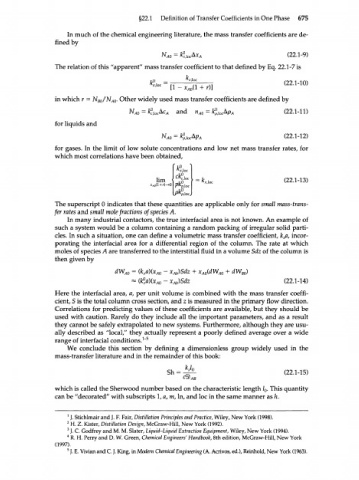
                                               lim         =  k xloc                 (22.1-13)

                                                      p,loc
                                                      k
                 The  superscript  0 indicates that these quantities are applicable  only  for  small mass-trans-
                 fer  rates and  small  mole fractions  of species  A.
                     In  many industrial  contactors, the true interfacial  area  is  not known.  An  example  of
                 such  a system  would  be  a column containing a random packing  of  irregular  solid  parti-
                 cles. In such  a situation, one can define  a volumetric  mass  transfer  coefficient,  k^,  incor-
                 porating  the  interfacial  area  for  a  differential  region  of  the  column. The  rate  at  which
                 moles  of species  A  are transferred  to the interstitial fluid  in a volume  Sdz of the column is
                 then given  by
                                   dW A0  =  (k a)(x A0  -  x )Sdz  + x (dW AQ  +  dW )
                                                    Ab
                                           x
                                                                         B0
                                                            A0
                                        «  <fia)(x AQ  ~  x )Sdz                     (22.1-14)
                                                    Ab
                 Here  the interfacial  area, a, per  unit  volume  is  combined  with  the mass  transfer  coeffi-
                 cient, S is the total column cross  section, and z is measured  in the primary  flow direction.
                 Correlations  for  predicting  values  of  these  coefficients  are available,  but  they  should  be
                 used  with  caution. Rarely  do they  include  all  the important parameters, and  as  a  result
                 they cannot be safely  extrapolated  to new  systems.  Furthermore, although  they are  usu-
                 ally  described  as  "local,"  they  actually  represent  a  poorly  defined  average  over  a  wide
                                           1 5
                 range  of interfacial conditions. "
                     We  conclude  this  section  by  defining  a  dimensionless  group  widely  used  in  the
                 mass-transfer  literature and in the remainder of this book:

                                                  Sh  =  - ^                         (22.1-15)

                                                                              /
                 which  is called  the Sherwood  number based  on the characteristic length . This quantity
                                                                               0
                 can  be "decorated" with  subscripts  \,a,m,  In, and loc in the same manner as h.
                      J. Stichlmair and J. F. Fair, Distillation Principles and Practice, Wiley, New York  (1998).
                     1
                      H. Z. Kister, Distillation Design, McGraw-Hill, New York  (1992).
                     2
                     3
                      J. C. Godfrey and M. M. Slater, Liquid-Liquid  Extraction  Equipment,  Wiley, New York  (1994).
                     4
                      R. H. Perry and D. W. Green, Chemical Engineers' Handbook, 8th edition, McGraw-Hill, New  York
                 (1997).
                      J. E. Vivian and C. J. King, in Modern Chemical Engineering (A. Acrivos, ed.), Reinhold, New York  (1963).
                     5

