


Page 685 - Bird R.B. Transport phenomena
P. 685
§21.5  Turbulent Mixing  and Turbulent Flow with Second-Order Reaction  665

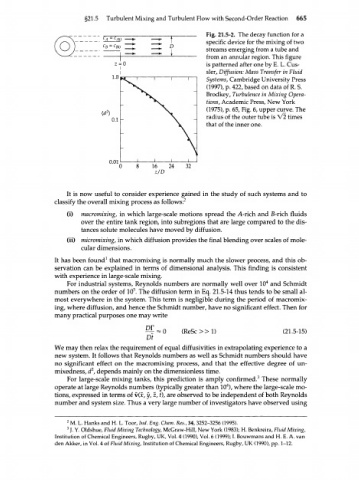
                                                   t          Fig. 21.5-2.  The decay  function of for a
                                                                    device
                                                              specific
                                                                                        two
                                                                            the mixing
                                                                          for
                                                   D
                                                              streams emerging  from  a tube and
                                                              from  an annular region. This  figure
                                                              is patterned after  one by  E. L. Cus-
                                                              sler, Diffusion: Mass Transfer in Fluid
                                                              Systems, Cambridge University  Press
                                                              (1997), p. 422, based  on data  of  R. S.
                                                              Brodkey, Turbulence in Mixing Opera-
                                                              tions, Academic Press, New York
                                                              (1975), p. 65, Fig. 6, upper curve. The
                                                              radius  of the outer tube is V2  times
                                                              that  of the inner one.


                                 0.01
                                                        32


                     It  is  now  useful  to consider  experience  gained  in  the study  of  such  systems  and  to
                 classify  the overall  mixing  process  as  follows: 2

                     (i)  macromixing,  in  which  large-scale  motions  spread  the Л-rich  and  B-rich  fluids
                         over  the entire tank region, into subregions  that are large  compared  to the dis-
                         tances solute molecules  have  moved  by  diffusion.
                     (ii)  micromixing,  in which  diffusion  provides  the final  blending  over  scales  of mole-
                         cular dimensions.
                 It has been  found 1  that macromixing  is  normally  much the slower  process, and  this ob-
                 servation  can  be  explained  in  terms  of  dimensional  analysis.  This  finding  is  consistent
                 with  experience  in large-scale  mixing.
                     For  industrial  systems,  Reynolds  numbers  are  normally  well  over  10 4  and  Schmidt
                 numbers  on the order  of  10\  The diffusion  term in  Eq. 21.5-14  thus tends  to be  small  al-
                 most  everywhere  in  the system.  This  term  is  negligible  during  the period  of  macromix-
                 ing, where  diffusion,  and hence the Schmidt number, have  no significant  effect.  Then  for
                 many practical purposes  one may  write

                                            DT   0     (ReSc»l)                     (21.5-15)
                                            Dt
                 We  may then relax  the requirement  of equal diffusivities  in extrapolating  experience  to a
                 new  system.  It follows  that Reynolds numbers as well as Schmidt numbers should  have
                 no  significant  effect  on  the  macromixing  process,  and  that  the  effective  degree  of  un-
                            2
                 mixedness, d , depends mainly  on the dimensionless  time.
                     For  large-scale  mixing  tanks,  this  prediction  is  amply  confirmed. 3  These  normally
                                                                    4
                 operate at large  Reynolds numbers  (typically  greater than 10 ), where the large-scale  mo-
                 tions, expressed  in terms  of  v(x,  j/, z, t), are observed  to be independent of both  Reynolds
                 number and system  size. Thus a very  large  number  of investigators  have observed  using


                     2  M. L. Hanks and  H. L. Toor, bid.  Eng. Cliem. Res., 34, 3252-3256  (1995).
                     3
                      J. Y. Oldshue, Fluid Mixing  Technology, McGraw-Hill, New York  (1983); H. Benkreira, Fluid  Mixing,
                 Institution  of Chemical Engineers, Rugby,  UK, Vol.  4 (1990), Vol.  6 (1999); I. Bouwmans and  H. E. A.  van
                 den  Akker,  in Vol.  4 of Fluid Mixing,  Institution of Chemical Engineers, Rugby,  UK (1990), pp.  1-12.

