


Page 185 - Volcanic Textures A Guide To The Interpretation of Textures In Volcanic Rocks
P. 185
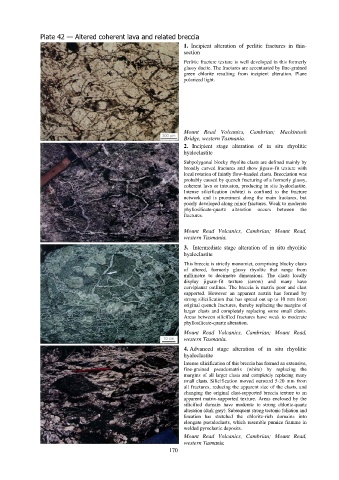
Plate 42 — Altered coherent lava and related breccia
                                                                  1. Incipient alteration of  perlitic fractures in thin-
                                                                  section
                                                                  Perlitic fracture texture is well developed in this formerly
                                                                  glassy dacite. The fractures are accentuated by fine-grained
                                                                  green  chlorite resulting from incipient  alteration. Plane
                                                                  polarized light.


                                                                  Mount Read Volcanics, Cambrian; Mackintosh
                                                                  Bridge, western Tasmania.
                                                                  2.  Incipient stage alteration  of in situ rhyolitic
                                                                  hyaloclastite
                                                                  Subpolygonal blocky rhyolite clasts are defined mainly by
                                                                  broadly curved fractures and show jigsaw-fit texture with
                                                                  local rotation of faintly flow-banded clasts. Brecciation was
                                                                  probably caused by quench fracturing of a formerly glassy,
                                                                  coherent lava or intrusion, producing in situ hyaloclastite.
                                                                  Intense silicification (white) is confined  to the fracture
                                                                  network and is prominent along the main fractures, but
                                                                  poorly developed along minor fractures. Weak to moderate
                                                                  phyllosilicate-quartz alteration occurs between the
                                                                  fractures.

                                                                  Mount Read Volcanics,  Cambrian; Mount  Read,
                                                                  western Tasmania.

                                                                  3.  Intermediate stage alteration of in situ  rhyolitic
                                                                  hyaloclastite
                                                                  This breccia is strictly monomict, comprising blocky clasts
                                                                  of altered, formerly glassy rhyolite that  range from
                                                                  millimetre to decimetre dimensions. The clasts locally
                                                                  display jigsaw-fit texture (arrow) and many have
                                                                  curviplanar outlines. The breccia is matrix poor and clast
                                                                  supported. However an apparent matrix has formed by
                                                                  strong silicification that has spread out up to 10 mm from
                                                                  original quench fractures, thereby replacing the margins of
                                                                  larger clasts and completely  replacing some small clasts.
                                                                  Areas between silicified fractures have weak to moderate
                                                                  phyllosilicate-quartz alteration.
                                                                  Mount Read Volcanics,  Cambrian; Mount  Read,
                                                                  western Tasmania.

                                                                  4. Advanced stage alteration  of in situ rhyolitic
                                                                  hyaloclastite
                                                                  Intense silicification of this breccia has formed an extensive,
                                                                  fine-grained  pseudomatrix (white) by replacing the
                                                                  margins  of all larger clasts and  completely replacing  many
                                                                  small clasts. Silicification moved outward 5-20 mm from
                                                                  all fractures, reducing the apparent size of the clasts, and
                                                                  changing  the  original clast-supported breccia texture to an
                                                                  apparent  matrix-supported texture.  Areas enclosed  by the
                                                                  silicified  domain  have moderate to strong  chlorite-quartz
                                                                  alteration (dark grey). Subsequent strong tectonic foliation and
                                                                  lineation has stretched the  chlorite-rich  domains  into
                                                                  elongate pseudoclasts, which resemble pumice fiamme in
                                                                  welded pyroclastic deposits.
                                                                  Mount Read Volcanics,  Cambrian; Mount  Read,
                                                                  western Tasmania.
                                                            170

