


Page 186 - Volcanic Textures A Guide To The Interpretation of Textures In Volcanic Rocks
P. 186
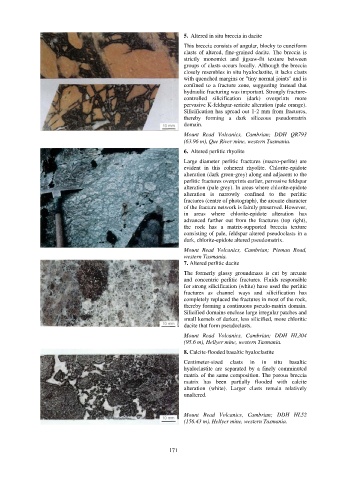
5.  Altered in situ breccia in dacite
                                                                  This breccia consists of angular, blocky to cuneiform
                                                                  clasts of altered, fine-grained dacite. The breccia is
                                                                  strictly  monomict and jigsaw-fit texture between
                                                                  groups of clasts occurs locally. Although the breccia
                                                                  closely resembles in situ hyaloclastite, it lacks clasts
                                                                  with quenched margins or "tiny normal joints" and is
                                                                  confined to a fracture zone,  suggesting instead that
                                                                  hydraulic fracturing was important. Strongly fracture-
                                                                  controlled silicification (dark) overprints  more
                                                                  pervasive K-feldspar-sericite alteration (pale orange).
                                                                  Silicification has spread out 1-2 mm from fractures,
                                                                  thereby forming a  dark siliceous  pseudomatrix
                                                                  domain.

                                                                  Mount Read  Volcanics, Cambrian;  DDH QR793
                                                                  (63.96 m), Que River mine, western Tasmania.
                                                                  6.  Altered perlitic rhyolite

                                                                  Large  diameter perlitic fractures  (macro-perlite) are
                                                                  evident in this coherent  rhyolite. Chlorite-epidote
                                                                  alteration (dark green-grey) along and adjacent to the
                                                                  perlitic fractures overprints earlier, pervasive feldspar
                                                                  alteration (pale grey). In areas where chlorite-epidote
                                                                  alteration is narrowly confined to the perlitic
                                                                  fractures (centre of photograph), the arcuate character
                                                                  of the fracture network is faintly preserved. However,
                                                                  in areas  where chlorite-epidote alteration  has
                                                                  advanced farther out from the fractures  (top right),
                                                                  the rock  has a matrix-supported  breccia texture
                                                                  consisting of pale, feldspar altered pseudoclasts in a
                                                                  dark, chlorite-epidote altered pseudomatrix.

                                                                  Mount Read  Volcanics, Cambrian; Pieman  Road,
                                                                  western Tasmania.
                                                                  7. Altered perlitic dacite
                                                                  The formerly glassy groundmass is cut by arcuate
                                                                  and concentric perlitic fractures.  Fluids  responsible
                                                                  for strong silicification (white) have used the perlitic
                                                                  fractures as channel ways and silicification has
                                                                  completely replaced the fractures in most of the rock,
                                                                  thereby forming a continuous pseudo-matrix domain.
                                                                  Silicified domains enclose large irregular patches and
                                                                  small kernels of darker, less silicified, more chloritic
                                                                  dacite that form pseudoclasts.
                                                                  Mount Read Volcanics,  Cambrian; DDH  HL304
                                                                  (95.6 m), Hellyer mine, western Tasmania.
                                                                  8. Calcite-flooded basaltic hyaloclastite

                                                                  Centimeter-sized  clasts  in  in  situ  basaltic
                                                                  hyaloclastite are separated  by a finely comminuted
                                                                  matrix of the same composition. The porous breccia
                                                                  matrix has  been partially flooded  with calcite
                                                                  alteration (white). Larger clasts remain  relatively
                                                                  unaltered.

                                                                  Mount Read Volcanics,  Cambrian; DDH  HL52
                                                                   (156.43 m), Hellyer mine, western Tasmania.


                                                            171

