


Page 189 - Volcanic Textures A Guide To The Interpretation of Textures In Volcanic Rocks
P. 189
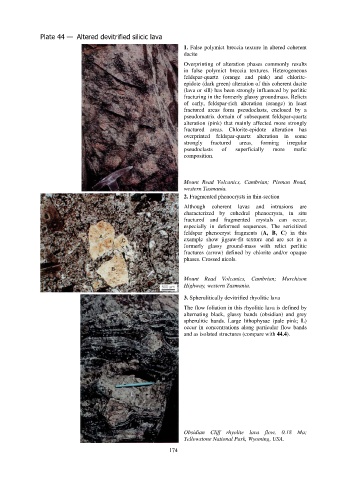
Plate 44 —  Altered devitrified silicic lava
                                                                  1. False polymict breccia texture in altered coherent
                                                                  dacite
                                                                  Overprinting  of alteration phases commonly results
                                                                  in false  polymict breccia textures.  Heterogeneous
                                                                  feldspar-quartz (orange and pink) and  chlorite-
                                                                  epidote (dark green) alteration of this coherent dacite
                                                                  (lava or sill) has been strongly influenced by perlitic
                                                                  fracturing in the formerly glassy groundmass. Relicts
                                                                  of early, feldspar-rich alteration (orange) in least
                                                                  fractured areas form pseudoclasts, enclosed by a
                                                                  pseudomatrix domain of  subsequent feldspar-quartz
                                                                  alteration (pink) that mainly affected more strongly
                                                                  fractured areas. Chlorite-epidote alteration has
                                                                  overprinted feldspar-quartz alteration  in some
                                                                  strongly  fractured  areas,  forming  irregular
                                                                  pseudoclasts  of  superficially  more  mafic
                                                                  composition.


                                                                  Mount Read  Volcanics, Cambrian; Pieman  Road,
                                                                  western Tasmania.
                                                                  2. Fragmented phenocrysts in thin-section
                                                                  Although coherent lavas and intrusions are
                                                                  characterized  by euhedral phenocrysts, in  situ
                                                                  fractured and fragmented crystals can occur,
                                                                  especially in deformed sequences. The sericitized
                                                                  feldspar  phenocryst fragments (A, B, C) in this
                                                                  example show jigsaw-fit texture and are set in a
                                                                  formerly glassy ground-mass with relict perlitic
                                                                  fractures (arrow) defined by  chlorite  and/or opaque
                                                                  phases. Crossed nicols.


                                                                  Mount Read Volcanics, Cambrian; Murchison
                                                                  Highway, western Tasmania.

                                                                  3. Spherulitically devitrified rhyolitic lava

                                                                  The flow foliation in this rhyolitic lava is defined by
                                                                  alternating black, glassy  bands  (obsidian) and grey
                                                                  spherulitic bands. Large lithophysae (pale pink;  L)
                                                                  occur in concentrations along particular  flow  bands
                                                                  and as isolated structures (compare with 44.4).


                                                                  Obsidian Cliff rhyolite lava flow, 0.18  Ma;
                                                                   Yellowstone National Park, Wyoming, USA.
                                                            174

