


Page 192 - Volcanic Textures A Guide To The Interpretation of Textures In Volcanic Rocks
P. 192
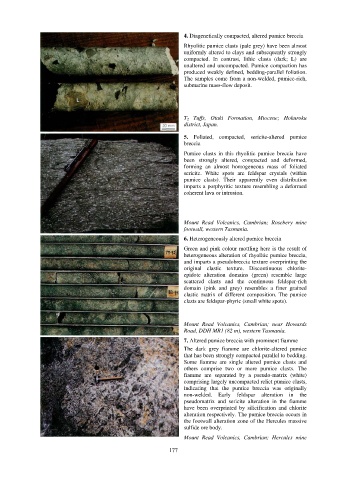
4. Diagenetically compacted, altered pumice breccia
                                                                  Rhyolitic pumice clasts (pale grey) have been almost
                                                                  uniformly altered to clays and subsequently strongly
                                                                  compacted. In contrast, lithic clasts (dark;  L) are
                                                                  unaltered and uncompacted. Pumice compaction has
                                                                  produced weakly defined, bedding-parallel foliation.
                                                                  The samples come from a non-welded, pumice-rich,
                                                                  submarine mass-flow deposit.


                                                                  T 2 Tuffs, Otaki Formation, Miocene;  Hokuroku
                                                                  district, Japan.

                                                                  5.  Foliated, compacted, sericite-altered pumice
                                                                  breccia
                                                                  Pumice clasts  in this rhyolitic pumice breccia have
                                                                  been strongly altered, compacted and  deformed,
                                                                  forming an almost homogeneous mass of foliated
                                                                  sericite.  White spots are  feldspar crystals (within
                                                                  pumice clasts). Their apparently even  distribution
                                                                  imparts a porphyritic texture resembling a deformed
                                                                  coherent lava or intrusion.


                                                                  Mount Read  Volcanics, Cambrian; Rosebery mine
                                                                   footwall, western Tasmania.
                                                                  6. Heterogeneously altered pumice breccia
                                                                  Green and pink colour mottling here is the result of
                                                                  heterogeneous alteration of rhyolitic pumice breccia,
                                                                  and imparts a pseudobreccia texture overprinting the
                                                                  original clastic texture.  Discontinuous chlorite-
                                                                  epidote alteration  domains (green) resemble large
                                                                  scattered clasts and the continuous feldspar-rich
                                                                  domain (pink  and  grey) resembles a finer grained
                                                                  clastic  matrix of  different composition. The pumice
                                                                  clasts are feldspar-phyric (small white spots).


                                                                  Mount Read  Volcanics, Cambrian;  near Howards
                                                                  Road, DDH MR1 (82 m), western Tasmania.

                                                                  7. Altered pumice breccia with prominent fiamme
                                                                  The dark grey fiamme are chlorite-altered pumice
                                                                  that has been strongly compacted parallel to bedding.
                                                                  Some fiamme are  single altered pumice clasts and
                                                                  others comprise two or more pumice clasts. The
                                                                  fiamme are separated  by a pseudo-matrix (white)
                                                                  comprising largely uncompacted relict pumice clasts,
                                                                  indicating that the pumice  breccia was  originally
                                                                  non-welded. Early feldspar alteration in the
                                                                  pseudomatrix  and sericite alteration in the fiamme
                                                                  have been  overprinted by  silicification and chlorite
                                                                  alteration respectively. The pumice breccia occurs in
                                                                  the footwall alteration zone of the Hercules massive
                                                                  sulfide ore body.
                                                                   Mount Read  Volcanics, Cambrian; Hercules mine

                                                            177

