


Page 194 - Volcanic Textures A Guide To The Interpretation of Textures In Volcanic Rocks
P. 194
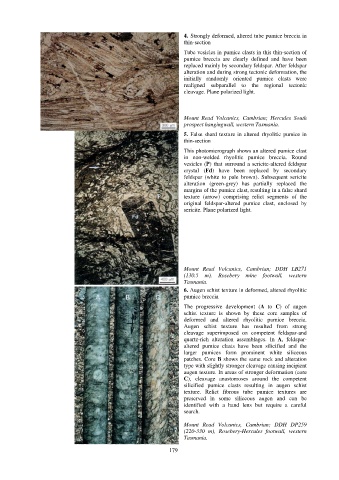
4.  Strongly deformed, altered tube pumice breccia in
                                                                  thin-section

                                                                  Tube vesicles in pumice clasts in this thin-section of
                                                                  pumice breccia are clearly  defined and  have been
                                                                  replaced mainly by secondary feldspar. After feldspar
                                                                  alteration and during strong tectonic deformation, the
                                                                  initially randomly oriented pumice clasts were
                                                                  realigned subparallel to the regional tectonic
                                                                  cleavage. Plane polarized light.


                                                                  Mount Read  Volcanics, Cambrian; Hercules South
                                                                  prospect hangingwall, western Tasmania.

                                                                  5. False shard texture in altered rhyolitic pumice in
                                                                  thin-section
                                                                  This photomicrograph shows an altered pumice clast
                                                                  in non-welded rhyolitic pumice breccia. Round
                                                                  vesicles (P) that surround a  sericite-altered feldspar
                                                                  crystal (Fd) have  been replaced by  secondary
                                                                  feldspar (white to pale brown). Subsequent sericite
                                                                  alteration (green-grey) has partially replaced the
                                                                  margins of the pumice clast, resulting in a false shard
                                                                  texture  (arrow) comprising  relict segments of the
                                                                  original feldspar-altered  pumice clast, enclosed by
                                                                  sericite. Plane polarized light.


                                                                  Mount Read  Volcanics, Cambrian; DDH LB271
                                                                  (130.5 m),  Rosebery mine footwall, western
                                                                  Tasmania.
                                                                  6. Augen schist texture in deformed, altered rhyolitic
                                                                  pumice breccia
                                                                  The progressive development (A to  C) of  augen
                                                                  schist texture is shown  by these core samples of
                                                                  deformed and altered rhyolitic pumice breccia.
                                                                  Augen schist texture has resulted from strong
                                                                  cleavage superimposed on  competent feldspar-and
                                                                  quartz-rich alteration assemblages. In  A, feldspar-
                                                                  altered pumice clasts have been silicified and the
                                                                  larger pumices form prominent  white  siliceous
                                                                  patches. Core B shows the same rock and alteration
                                                                  type with slightly stronger cleavage causing incipient
                                                                  augen texture. In areas of stronger deformation (core
                                                                  C), cleavage anastomoses around the  competent
                                                                  silicified pumice clasts resulting in augen schist
                                                                  texture. Relict fibrous tube pumice textures are
                                                                  preserved in  some siliceous augen and can be
                                                                  identified with a hand lens but  require a careful
                                                                  search.

                                                                  Mount Read  Volcanics, Cambrian;  DDH DP259
                                                                  (220-330 m),  Rosebery-Hercules footwall, western
                                                                  Tasmania.

                                                            179

