


Page 190 - Volcanic Textures A Guide To The Interpretation of Textures In Volcanic Rocks
P. 190
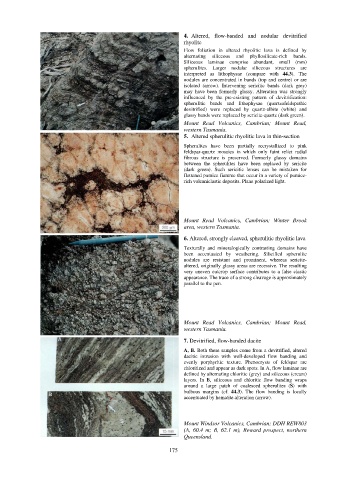
4.  Altered, flow-banded and nodular  devitrified
                                                                  rhyolite
                                                                  Flow foliation in altered rhyolitic lava is defined  by
                                                                  alternating siliceous and  phyllosilicate-rich bands.
                                                                  Siliceous laminae comprise abundant, small (mm)
                                                                  spherulites. Larger nodular  siliceous structures are
                                                                  interpreted as  lithophysae (compare with  44.3). The
                                                                  nodules are concentrated in bands (top and centre) or are
                                                                  isolated (arrow). Intervening sericitic bands (dark grey)
                                                                  may have been formerly glassy. Alteration was strongly
                                                                  influenced by the pre-existing  pattern of devitrification:
                                                                  spherulitic bands and lithophysae (quartzofeldspathic
                                                                  devitrified) were replaced by  quartz-albite (white)  and
                                                                  glassy bands were replaced by sericite-quartz (dark green).
                                                                  Mount Read Volcanics,  Cambrian; Mount  Read,
                                                                   western Tasmania.
                                                                  5.  Altered spherulitic rhyolitic lava in thin-section
                                                                  Spherulites have been partially recrystallized to pink
                                                                  feldspar-quartz  mosaics in which only  faint relict radial
                                                                  fibrous structure is preserved. Formerly glassy domains
                                                                  between the spherulites have  been replaced by sericite
                                                                  (dark green). Such sericitic lenses can be mistaken for
                                                                  flattened pumice fiamme that occur in a variety of pumice-
                                                                  rich volcaniclastic deposits. Plane polarized light.


                                                                  Mount Read  Volcanics, Cambrian; Winter Brook
                                                                  area, western Tasmania.

                                                                  6. Altered, strongly cleaved, spherulitic rhyolitic lava
                                                                  Texturally and mineralogically contrasting domains have
                                                                  been  accentuated by weathering. Silicified  spherulite
                                                                  nodules are resistant and prominent, whereas sericite-
                                                                  altered, originally glassy areas are recessive. The resulting
                                                                  very uneven outcrop surface contributes to a false clastic
                                                                  appearance. The trace of a strong cleavage is approximately
                                                                  parallel to the pen.


                                                                  Mount Read Volcanics,  Cambrian; Mount  Read,
                                                                  western Tasmania.

                                                                  7. Devitrified, flow-banded dacite
                                                                  A, B. Both these samples come from a devitrified, altered
                                                                  dacitic intrusion with well-developed flow banding and
                                                                  evenly porphyritic texture. Phenocrysts of feldspar are
                                                                  chloritized and appear as dark spots. In A, flow laminae are
                                                                  defined by alternating chloritic (grey) and siliceous (cream)
                                                                  layers. In B, siliceous and chloritic flow banding wraps
                                                                  around a large patch of  coalesced spherulites (S) with
                                                                  bulbous margins (cf.  44.3). The flow banding is locally
                                                                  accentuated by hematite alteration (arrow).


                                                                  Mount Windsor Volcanics, Cambrian; DDH REW803
                                                                  (A, 60.4 m; B, 62.1 m), Reward prospect,  northern
                                                                   Queensland.

                                                            175

