


Page 352 - Water Loss Control
P. 352
Contr olling Real Losses—Pr essur e Management      321


                                                  Location Diagram
                                        Drive way    Pavement       Wall  Tree

                                    Post
                                                        ~ 9000
                             RUA G/WFA  Pavement = 2460  6320  4500  Manhole Manhole  200  RUA Ararltagllara
                                                            Center line for reference
                                                                            750
                                        1550
                                                                              1500
                                                                            750
                                 3130   1230
                                           200      3700    200  1600  200  200
                                                                                        Flow
                                                   RUA amambay                     Pipe ∅ 600
                                                                 Internal dimensions
                                                                 Width: 1500 mm
                                                                 Length: 5500 mm
                                                                 Depth: ~1700 mm
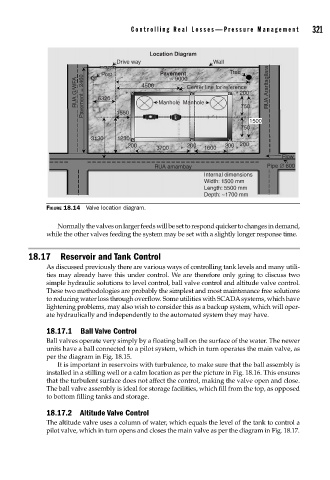
                    FIGURE 18.14  Valve location diagram.


                       Normally the valves on larger feeds will be set to respond quicker to changes in demand,
                    while the other valves feeding the system may be set with a slightly longer response time.


               18.17  Reservoir and Tank Control
                    As discussed previously there are various ways of controlling tank levels and many utili-
                    ties may already have this under control. We are therefore only going to discuss two
                    simple hydraulic solutions to level control, ball valve control and altitude valve control.
                    These two methodologies are probably the simplest and most maintenance free solutions
                    to reducing water loss through overflow. Some utilities with SCADA systems, which have
                    lightening problems, may also wish to consider this as a backup system, which will oper-
                    ate hydraulically and independently to the automated system they may have.
                    18.17.1 Ball Valve Control
                    Ball valves operate very simply by a floating ball on the surface of the water. The newer
                    units have a ball connected to a pilot system, which in turn operates the main valve, as
                    per the diagram in Fig. 18.15.
                       It is important in reservoirs with turbulence, to make sure that the ball assembly is
                    installed in a stilling well or a calm location as per the picture in Fig. 18.16. This ensures
                    that the turbulent surface does not affect the control, making the valve open and close.
                    The ball valve assembly is ideal for storage facilities, which fill from the top, as opposed
                    to bottom filling tanks and storage.

                    18.17.2 Altitude Valve Control
                    The altitude valve uses a column of water, which equals the level of the tank to control a
                    pilot valve, which in turn opens and closes the main valve as per the diagram in Fig. 18.17.

