


Page 347 - Water Loss Control
P. 347
316    Cha pte r  Ei g h tee n


                       Care should be taken when measuring flows to ensure that these flows are easily
                    related to changing seasonal trends. Obviously the best situation in areas of changing
                    demands is to monitor for 1 year, however this is very rarely possible. The next best
                    thing is to normalize annual demands and to relate the week of flow monitoring to the
                    normalized curve for security.
                       Flows should be measured accurately with calibrated equipment, however an accu-
                    racy of ±10% is usually acceptable, as the valves to be installed have quite a wide range.


               18.8 Pressure Measurements
                    Pressure measurements should be taken at all of the node points mentioned above. Pressure
                    should be measured with a reasonably high-resolution logger (±0.1% full scale), which
                    should be calibrated for accuracy and drift before and after the field installation. Further
                    information on the measuring process, recommended above can be found in App. B.


               18.9    Using Hydraulic Computer Models to Identify
                       Ideal Locations for Installation
                    It is not necessary to have a computer hydraulic model to select areas for pressure con-
                    trol. However if one is available then it can be used, to identify areas with high pres-
                    sures and also to identify areas of high head loss, where the more advanced dynamic
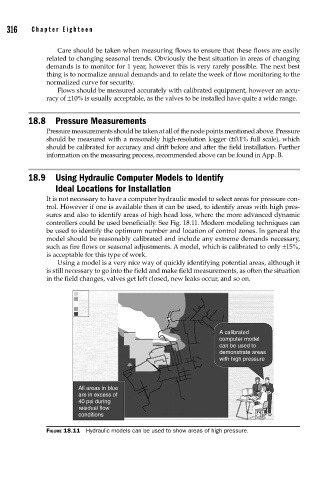
                    controllers could be used beneficially. See Fig. 18.11. Modern modeling techniques can
                    be used to identify the optimum number and location of control zones. In general the
                    model should be reasonably calibrated and include any extreme demands necessary,
                    such as fire flows or seasonal adjustments. A model, which is calibrated to only ±15%,
                    is acceptable for this type of work.
                       Using a model is a very nice way of quickly identifying potential areas, although it
                    is still necessary to go into the field and make field measurements, as often the situation
                    in the field changes, valves get left closed, new leaks occur, and so on.


                                                                      A calibrated
                                                                      computer model
                                                                      can be used to
                                                                      demonstrate areas
                                                                      with high pressure


                             All areas in blue
                             are in excess of
                             40 psi during
                             residual flow
                             conditions
                    FIGURE 18.11  Hydraulic models can be used to show areas of high pressure.

