


Page 344 - Water Loss Control
P. 344
Contr olling Real Losses—Pr essur e Management      313


                       An example could be:

                        Q.   A zone with fixed area leakage has a leak rate of 500 gpm at 80 psi. If the pressure were reduced
                           to 50 psi, what would the savings in leakage rate be?

                                    0.5
                                                         0.5
                        A.  L  = L (P /P ) = New leakage = 500(50/80)  = 500 − 395 = 105 gpm
                            1  0  1  0
                    18.4.2  Fixed and Variable Paths
                    Leakage can be described in either fixed or variable paths. Fixed area leakage could be
                    pinholes in galvanized service line or a hole in a cast-iron pipe. This type of leakage
                    follows the traditional calculation shown in the last paragraph. Savings through reduc-
                    tion in fixed area leakage are usually more conservative than in areas with variable area
                    leakage.
                       Variable area leakage normally occurs in systems with some kind of PVC or plastic
                    based pipe, systems with joint leaks (often found in systems with AC piping or old
                    hydraulic couplings) and systems with high background leakage.
                       Variable area leakage is not calculated using the traditional square root power but
                    rather a power which is very much system dependent. N1 values range from 0.6 to 2.5
                    and should be calculated on a zone-by-zone basis. International research has however
                    identified an N1 of 1.15, as being representative of large zones with varied materials.
                       Calculating the N1 is quite simple and can be undertaken in the field with either
                    data loggers or manually by flow and pressure readings. This type of testing is com-
                    monly referred to as step testing.
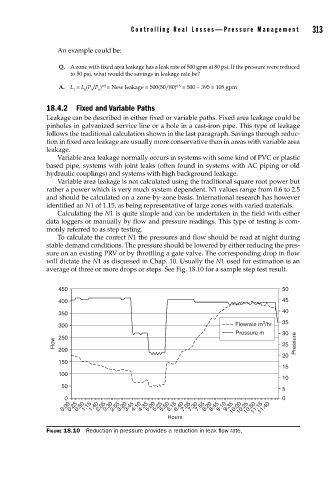
                       To calculate the correct N1 the pressures and flow should be read at night during
                    stable demand conditions. The pressure should be lowered by either reducing the pres-
                    sure on an existing PRV or by throttling a gate valve. The corresponding drop in flow
                    will dictate the N1 as discussed in Chap. 10. Usually the N1 used for estimation is an
                    average of three or more drops or steps. See Fig. 18.10 for a sample step test result.


                        450                                                             50
                        400                                                             45
                                                                                        40
                        350
                                                                                  3
                        300                                               Flowrate m /hr  35
                                                                          Pressure m    30
                        250
                       Flow                                                             25  Pressure
                        200
                                                                                        20
                        150
                                                                                        15
                        100
                                                                                        10
                         50
                                                                                        5
                         0                                                              0
                         0:00 0:25 0:50  1:15 1:40 2:05 2:30 2:55 3:20  3:45  4:10 4:35 5:00 5:25 5:50 6:15  6:40 7:05 7:30 7.55 8:20 8:45 9:10  9:35 10:00 10:25 10:50 11:15 11:40
                                                       Hours
                    FIGURE 18.10  Reduction in pressure provides a reduction in leak fl ow rate.

