


Page 289 - Mechanical Behavior of Materials
P. 289
290                               Chapter 7  Yielding and Fracture under Combined Stresses


               Combining Eqs. 7.30 and 7.31 gives the yield criterion in the desired form, expressed in terms
            of the uniaxial yield strength:

                              1           2          2          2
                        σ o = √   (σ 1 − σ 2 ) + (σ 2 − σ 3 ) + (σ 3 − σ 1 )  (at yielding)  (7.34)
                               2

            As before, the effective stress for this theory is most conveniently defined so that it equals the
            uniaxial strength σ o at the point of yielding:

                                     1
                                                 2
                                                            2
                               ¯ σ H = √  (σ 1 − σ 2 ) + (σ 2 − σ 3 ) + (σ 3 − σ 1 ) 2  (7.35)
                                      2
            Here, the subscript H specifies that this effective stress is determined by the octahedral shear stress
            criterion. Also, the corresponding safety factor is X = σ o / ¯σ H . This effective stress may also be
            determined directly for any state of stress, without the necessity of first determining principal
            stresses, by modifying Eq. 7.35 with the use of Eqs. 6.33 and 6.36. The result is

                            1
                                        2
                                                                    2
                                                                              2
                                                   2
                                                              2
                      ¯ σ H = √  (σ x − σ y ) + (σ y − σ z ) + (σ z − σ x ) + 6(τ xy  + τ 2 yz  + τ )  (7.36)
                                                                              zx
                             2
            7.5.2 Graphical Representation of the Octahedral Shear Stress Criterion
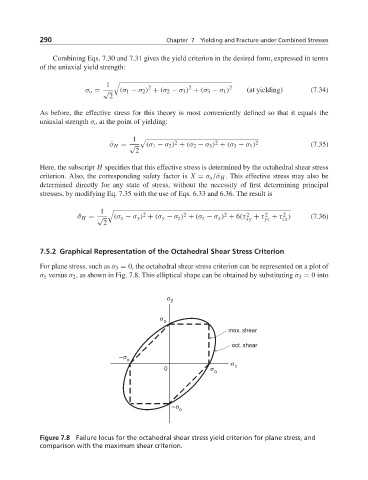
            For plane stress, such as σ 3 = 0, the octahedral shear stress criterion can be represented on a plot of
            σ 1 versus σ 2 , as shown in Fig. 7.8. This elliptical shape can be obtained by substituting σ 3 = 0into

                                               σ
                                                2

                                             σ
                                              o
                                                               max. shear

                                                                oct. shear
                                  –σ
                                    o                           σ
                                              0            σ     1
                                                            o


                                                –σ
                                                  o


            Figure 7.8 Failure locus for the octahedral shear stress yield criterion for plane stress, and
            comparison with the maximum shear criterion.

