


Page 439 - The ISA Handbook in Contemporary Sociology
P. 439
9781412934633-Chap-27  1/10/09  8:57 AM  Page 410


                   410               THE ISA HANDBOOK IN CONTEMPORARY SOCIOLOGY


                   control over regional government than in  was a perception of much more foreign
                   most other countries of Europe.         investment, some increase in tourists, and in
                     Since Russia established a new political  Russia, of foreign workers.  There is little
                   regime in 1993, its official position is that its  increase in perceived impact from the global
                   political system is democratic. Even after a  media, but the democratic values of tolerance
                   shift was made (after the re-election of Putin  changed remarkably during this time.
                   in 2004) to more centralized political control  A few of the variables highlight the
                   in a strong presidential system by a law cur-  changes from 1995 to 2001 in Poland
                   tailing direct elections of governors of  and from 1995 to 2003 in Russia. The main
                   regions in favor of appointment by the cen-  macro difference of specific political rele-
                   tral government, the official interpretation is  vance to globalization between these two
                   that Russian democracy is compatible with  countries was that Poland in 2001 was in the
                   the democratic standards subscribed to by  midst of preparations for joining the EU,
                   members of the EU.                      scheduled for 2004, and moving to greater
                     Data about what happened to the democratic  global engagement, while in Russia there
                   values, beliefs, and practices of local political  were clear signals that the Presidency would
                   leaders from 1995 to 2001–03 will be high-  be strengthening central institutions at the
                   lighted, with Sweden as a contrasting ‘control’  expense of regional and local autonomy. That
                   country. (Sweden stands out as the ‘most dem-  process appears to have continued from the
                   ocratic’ country of all the 29 countries in this  time of the study throughout the terms of
                   study on nearly all the comparative measures  office of President Putin.
                   used in this research.) The evidence is that the
                   big changes in the newly ‘globalized’countries
                   occurred at the very beginning of the demo-  Democratic values
                   cratic ‘revolutions’, during the early 1990s.
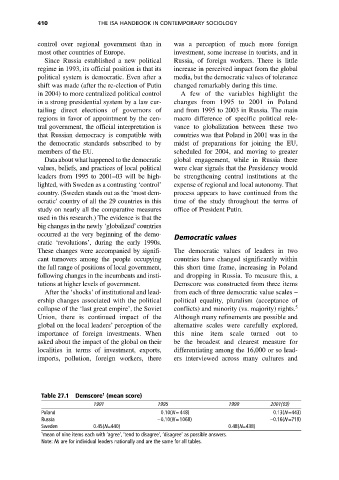
                   These changes were accompanied by signifi-  The democratic values of leaders in two
                   cant turnovers among the people occupying  countries have changed significantly within
                   the full range of positions of local government,  this short time frame, increasing in Poland
                   following changes in the incumbents and insti-  and dropping in Russia. To measure this, a
                   tutions at higher levels of government.  Demscore was constructed from three items
                     After the ‘shocks’of institutional and lead-  from each of three democratic value scales –
                   ership changes associated with the political  political equality, pluralism (acceptance of
                   collapse of the ‘last great empire’, the Soviet  conflicts) and minority (vs. majority) rights. 5
                   Union, there is continued impact of the  Although many refinements are possible and
                   global on the local leaders’ perception of the  alternative scales were carefully explored,
                   importance of foreign investments.  When  this nine item scale turned out to
                   asked about the impact of the global on their  be the broadest and clearest measure for
                   localities in terms of investment, exports,  differentiating among the 16,000 or so lead-
                   imports, pollution, foreign workers, there  ers interviewed across many cultures and


                    Table 27.1  Demscore (mean score)
                                      1
                                   1991               1995                 1999        2001(03)
                    Poland                             0.10(N=448)                      0.13(N=443)
                    Russia                            −0.10(N=1068)                    −0.16(N=719)
                    Sweden         0.45(N=440)                             0.48(N=438)
                    1 mean of nine items each with ‘agree’, ‘tend to disagree’, ‘disagree’ as possible answers.
                    Note: Ns are for individual leaders nationally and are the same for all tables.

